Early Stoa
Chrysippus
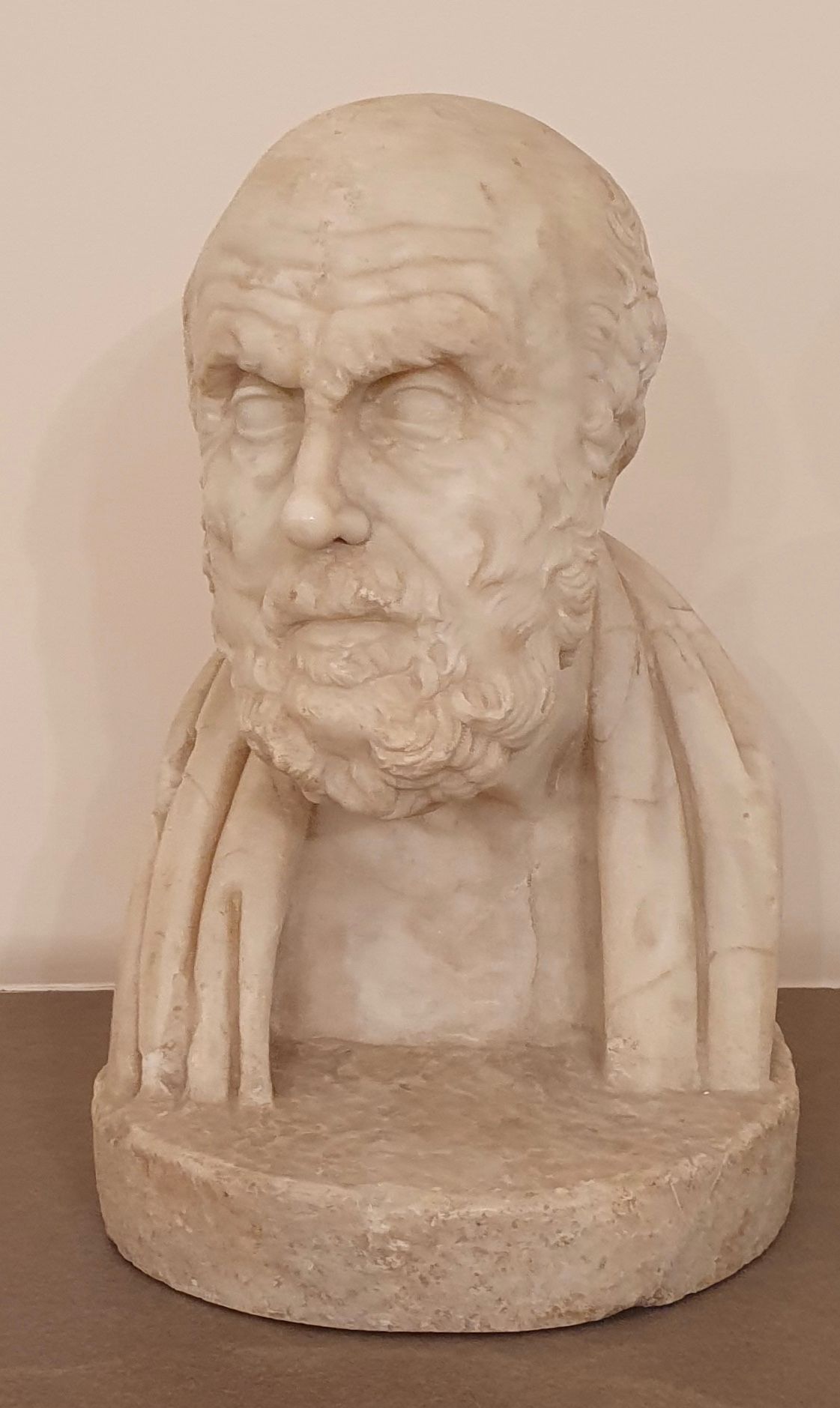
Χρύσιππος
c. 279 – c. 206 BC
Bust of Chrysippus, Augustan copy of a late 3rd-century BC original. Photo: Yair-haklai · CC BY-SA 4.0 · Wikimedia Commons
Third head of the Stoa and the great systematiser of its doctrine; later Stoics treated his works as the standard account.
Biography · editorial
Chrysippus came from Soli in Cilicia and studied under Cleanthes, whom he succeeded as head of the school. He was a famously prolific writer: Diogenes Laërtius credits him with more than seven hundred books, none of which survive complete.
He gave Stoicism its mature form. He developed Stoic logic into a powerful system of propositional reasoning, worked out the theory of impressions and assent, analysed the passions as mistaken judgements, and defended the compatibility of fate with human responsibility. Ancient writers said that without Chrysippus there would have been no Stoa.
Much of what is known of his views comes from opponents. Plutarch’s essays On Stoic Self-Contradictions and Against the Stoics on Common Conceptions, both in the Library, quote him at length in order to attack him.
In the Library
Ancient accounts of Chrysippus
Passages that mention Chrysippus
144 passages in 14 works, found by name in the English translations. This is a first-pass index: a few matches may be namesakes.
Lives of Eminent Philosophers, Book VII · 57
- Lives 7.1 — …fairly tall, and swarthy—hence some one called him an Egyptian vine-branch, according to Chrysippus in the first book of his Proverbs. He had thick legs; he was flabby and delicate. Hence…
- Lives 7.34 — That the Republic is the work of Zeno is attested by Chrysippus in his De Republica. And he discussed amatory subjects in the beginning of that book of…
- Lives 7.35 — …that an epitome of the political history of Rome and Carthage; the fifth a pupil of Chrysippus, who left few writings but many disciples; the sixth a physician of the school of…
- Lives 7.39 — …Zeno of Citium was the first to make this division in his Exposition of Doctrine, and Chrysippus too did so in the first book of his Exposition of Doctrine and the first book of his…
Show 53 more
- Lives 7.40 — …finish with Ethics; and among those who so do are Zeno in his treatise On Exposition, Chrysippus, Archedemus and Eudromus.
- Lives 7.50 — …act of imprinting something on the soul, that is a process of change, as is set forth by Chrysippus in the second book of his treatise Of the Soul (De anima). For, says he, we must not…
- Lives 7.54 — …be the apprehending presentation, i.e. that which comes from a real object—according to Chrysippus in the twelfth book of his Physics and to Antipater and Apollodorus. Boëthus, on the…
- Lives 7.55 — …I may cite for this Archedemus in his treatise On Voice, Diogenes, Antipater and Chrysippus in the second book of his Physics.
- Lives 7.57 — …of discourse. There are, as stated by Diogenes in his treatise on Language and by Chrysippus, five parts of speech: proper name, common noun, verb, conjunction, article. To these…
- Lives 7.60 — …which, when a sentence is analysed, is uttered with complete meaning; or, according to Chrysippus in his book On Definitions, is a rendering back one’s own. Delineation is a statement…
- Lives 7.62 — …science dealing with truth, falsehood, and that which is neither true nor false; whereas Chrysippus takes its subject to be signs and things signified. Such then is the gist of what the…
- Lives 7.65 — …or false, or a thing complete in itself, capable of being denied in and by itself, as Chrysippus says in his Dialectical Definitions: A judgement is that which in and by itself can be…
- Lives 7.68 — …whereas judgements (or propositions) are always either true or false. The followers of Chrysippus, Archedemus, Athenodorus, Antipater and Crinis divide propositions into simple and not…
- Lives 7.71 — Of propositions that are not simple the hypothetical, according to Chrysippus in his Dialectics and Diogenes in his Art of Dialectic, is one that is formed by means…
- Lives 7.79 — …in the construction of every argument. As to the number of these, authorities differ; Chrysippus makes them five. These are assumed alike in reasoning specifically conclusive and in…
- Lives 7.84 — …inducements to act or refrain from acting. The foregoing is the subdivision adopted by Chrysippus, Archedemus, Zeno of Tarsus, Apollodorus, Diogenes, Antipater, and Posidonius, and their…
- Lives 7.85 — …Stoics, is to selfpreservation, because nature from the outset endears it to itself, as Chrysippus affirms in the first book of his work On Ends: his words are, The dearest thing to every…
- Lives 7.87 — …is equivalent to living in accordance with experience of the actual course of nature, as Chrysippus says in the first book of his De finibus; for our individual natures are parts of the…
- Lives 7.89 — By the nature with which our life ought to be in accord, Chrysippus understands both universal nature and more particularly the nature of man, whereas…
- Lives 7.91 — …is that it is the opposite of virtue. That it, virtue, can be taught is laid down by Chrysippus in the first book of his work On the End, by Cleanthes, by Posidonius in his…
- Lives 7.92 — …by the school of Posidonius four types are recognized, and more than four by Cleanthes, Chrysippus, Antipater, and their followers. Apollophanes for his part counts but one, namely,…
- Lives 7.101 — …only the morally beautiful is good. So Hecato in his treatise On Goods, book iii., and Chrysippus in his work On the Morally Beautiful. They hold, that is, that virtue and whatever…
- Lives 7.102 — …This Hecato affirms in his De fine, book vii., and also Apollodorus in his Ethics. and Chrysippus. For, say they, such things (as life, health, and pleasure) are not in themselves goods,…
- Lives 7.103 — …these things too are among goods. Hecato in the ninth book of his treatise On Goods, and Chrysippus in his work On Pleasure, deny that pleasure is a good either; for some pleasures are…
- Lives 7.111 — They hold the emotions to be judgements, as is stated by Chrysippus in his treatise On the Passions: avarice being a supposition that money is a good, while…
- Lives 7.120 — …to the good, but not to the bad. It is one of their tenets that sins are all equal: so Chrysippus in the fourth book of his Ethical Questions, as well as Persaeus and Zeno. For if one…
- Lives 7.121 — …that the wise man will take part in politics, if nothing hinders him—so, for instance, Chrysippus in the first book of his work On Various Types of Life—since thus he will restrain vice…
- Lives 7.122 — …also kings; kingship being irresponsible rule, which none but the wise can maintain: so Chrysippus in his treatise vindicating Zeno’s use of terminology. For he holds that knowledge of…
- Lives 7.125 — …possessor of one is the possessor of all, inasmuch as they have common principles, as Chrysippus says in the first book of his work On Virtues, Apollodorus in his Physics according to…
- Lives 7.127 — …of justice and injustice; and the same rule applies to the other virtues. Further, while Chrysippus holds that virtue can be lost, Cleanthes maintains that it cannot. According to the…
- Lives 7.128 — …justice, as well as law and right reason, exists by nature and not by convention: so Chrysippus in his work On the Morally Beautiful.
- Lives 7.129 — …that rate we should have to give up life altogether: so Posidonius in his Exhortations. Chrysippus allows that the ordinary Greek education is serviceable. It is their doctrine that…
- Lives 7.130 — …she hated him. By which it is shown, they think, that love depends upon regard, as Chrysippus says in his treatise Of Love, and is not sent by the gods. And beauty they describe as…
- Lives 7.131 — …be a community of wives with free choice of partners, as Zeno says in his Republic and Chrysippus in his treatise On Government [and not only they, but also Diogenes the Cynic and…
- Lives 7.134 — …down by Zeno of Citium in his treatise On Existence, Cleanthes in his work On Atoms, Chrysippus in the first book of his Physics towards the end, Archedemus in his treatise On…
- Lives 7.136 — …fire, water, air, earth. They are discussed by Zeno in his treatise On the Whole, by Chrysippus in the first book of his Physics, and by Archedemus in a work On Elements. An element is…
- Lives 7.138 — …has his seat. The world, in their view, is ordered by reason and providence: so says Chrysippus in the fifth book of his treatise On Providence and Posidonius in his work On the Gods,…
- Lives 7.139 — …principle: so says Antipater of Tyre in the eighth book of his treatise On the Cosmos. Chrysippus in the first book of his work On Providence and Posidonius in his book On the Gods say…
- Lives 7.140 — …result of the sympathy and tension which binds together things in heaven and earth. Chrysippus discusses the void in his work On Void and in the first book of his Physical Sciences;…
- Lives 7.142 — …and the destruction of the world are discussed by Zeno in his treatise On the Whole, by Chrysippus in the first book of his Physics, by Posidonius in the first book of his work On the…
- Lives 7.143 — …thing. The unity of the world is maintained by Zeno in his treatise On the Whole, by Chrysippus, by Apollodorus in his Physics, and by Posidonius in the first book of his Physical…
- Lives 7.148 — …substance of God is declared by Zeno to be the whole world and the heaven, as well as by Chrysippus in his first book Of the Gods, and by Posidonius in his first book with the same title.…
- Lives 7.149 — …of human craftsmanship. That all things happen by fate or destiny is maintained by Chrysippus in his treatise De fato, by Posidonius in his De fato, book ii., by Zeno and by Boëthus…
- Lives 7.150 — The primary matter they make the substratum of all things: so Chrysippus in the first book of his Physics, and Zeno. By matter is meant that out of which…
- Lives 7.151 — Hence, again, their explanation of the mixture of two substances is, according to Chrysippus in the third book of his Physics, that they permeate each other through and through, and…
- Lives 7.157 — …indeed holds that all souls continue to exist until the general conflagration; but Chrysippus says that only the souls of the wise do so. They count eight parts of the soul: the…
- Lives 7.159 — Chrysippus in the second book of his Physics declares it to be in substance identical with vital…
- Lives 7.179 — Chrysippus, the son of Apollonius, came either from Soli or from Tarsus, as Alexander relates in…
- Lives 7.180 — …thought, if the gods took to dialectic, they would adopt no other system than that of Chrysippus. He had abundance of matter, but in style he was not successful. In industry he…
- Lives 7.181 — …force and originality unaided by quotations was far greater in amount than the books of Chrysippus, says, to quote his exact words, If one were to strip the books of Chrysippus of all…
- Lives 7.182 — …some dialectician got up and attacked Cleanthes, proposing sophistical fallacies to him, Chrysippus called to him, Cease to distract your elder from matters of importance; propound such…
- Lives 7.183 — …quietly, though he was unsteady on his legs; which caused the woman-slave to say, As for Chrysippus, only his legs get tipsy. His opinion of himself was so high that when some one…
- Lives 7.184 — …by Apollodorus in his Chronology. I have toyed with the subject in the following verses: Chrysippus turned giddy after gulping down a draught of Bacchus; he spared not the Porch nor his…
- Lives 7.185 — …himself or else to send some one to his court, Sphaerus undertook the journey, while Chrysippus declined to go. On the other hand, he sent for his sister’s sons, Aristocreon and…
- Lives 7.186 — There was another Chrysippus, a native of Cnidus, a physician, to whom Erasistratus says that he was under great…
- Lives 7.187 — …ergo you have horns. Others attribute this to Eubulides. There are people who run Chrysippus down as having written much in a tone that is gross and indecent. For in his work On the…
- Lives 7.188 — …is moreover not even mentioned by bibliographers, who wrote on the titles of books. What Chrysippus makes of it is not to be found in Polemo nor Hypsicrates, no, nor even in Antigonus. It…
On Stoic Self-Contradictions · 29
- Plutarch, On Stoic Self-Contradictions 2 — …discourses many things written by Zeno himself, many by Cleanthes, and most of all by Chrysippus, concerning policy, governing, and being governed, concerning judging and pleading, and…
- Plutarch, On Stoic Self-Contradictions 4 — Indeed Antipater, in his writings concerning the difference between Cleanthes and Chrysippus, has related that Zeno and Cleanthes would not be made citizens of Athens, lest they…
- Plutarch, On Stoic Self-Contradictions 5 — Again, Chrysippus, writing in his treatise of Rhetoric, that a wise man will so plead and so act in the…
- Plutarch, On Stoic Self-Contradictions 7 — …it comes to action. Nor does Zeno alone seem to contradict himself in these matters; but Chrysippus also, who blames Ariston for saying that the other virtues are different habits of one…
Show 25 more
- Plutarch, On Stoic Self-Contradictions 9 — Chrysippus is of opinion, that young students should first learn logic, secondly, ethics, and after…
- Plutarch, On Stoic Self-Contradictions 10 — …that Carneades said nothing of his own, but that catching hold of those arguments which Chrysippus alleged for the contrary opinion, he assaulted with them his positions, and often cried…
- Plutarch, On Stoic Self-Contradictions 12 — Chrysippus says, that nothing is profitable to the wicked, that the wicked have neither use nor…
- Plutarch, On Stoic Self-Contradictions 13 — And this opinion is consequent to their principal ones. It is moreover manifest that Chrysippus, though he has also written many things to the contrary, lays this for a position, that…
- Plutarch, On Stoic Self-Contradictions 14 — …to oblige us to depart. Nor is it necessary to turn over other books, that we may show Chrysippus’s contradictoriness to himself; but in these same, he sometimes with commendation brings…
- Plutarch, On Stoic Self-Contradictions 16 — …it within them, but sets the wicked man against himself, and molests and disturbs him; Chrysippus, blaming this, affirms that it is absurdly said, A man injures himself; for that…
- Plutarch, On Stoic Self-Contradictions 18 — …with regard to happiness unhappiness is to be preferred. But neither, say they, does Chrysippus altogether think that the remaining in life is to be reckoned amongst good things, or…
- Plutarch, On Stoic Self-Contradictions 19 — Chrysippus confesses that good things are totally different from bad; and it must of necessity be…
- Plutarch, On Stoic Self-Contradictions 20 — …from Epicurus, who takes away Providence that he may leave God in repose. But the same Chrysippus in his First Book of Lives says, that a wise man willingly takes upon him a kingdom,…
- Plutarch, On Stoic Self-Contradictions 23 — …this adventitious power of the soul, seizing on its inclination, determines the doubt. Chrysippus, discoursing against these men, as offering violence to Nature by devising an effect…
- Plutarch, On Stoic Self-Contradictions 27 — Chrysippus also says, that the virtues follow one another, and that not only he who has one has…
- Plutarch, On Stoic Self-Contradictions 29 — …who all say that the drink passes through the lungs. But all the arithmeticians refel Chrysippus, amongst whom also is Hipparchus, demonstrating that the error of his computation is…
- Plutarch, On Stoic Self-Contradictions 30 — …as he called them, cannot be disposed of, either as good or as indifferent. But Chrysippus has made the matter yet far more intricate; for he sometimes says, that they are mad who…
- Plutarch, On Stoic Self-Contradictions 31 — …virtue and strength; so that they do no more aid men than they are aided by them. Now Chrysippus neither professes himself nor any one of his disciples and teachers to be virtuous. What…
- Plutarch, On Stoic Self-Contradictions 32 — …to colonies unless these men know of some cities built in hell and under the earth. But Chrysippus makes God like to Deïotarus, the Galatian king, who having many sons, and being desirous…
- Plutarch, On Stoic Self-Contradictions 33 — …therefore can be more filthy to men than the mutual killing of one another? —to which Chrysippus says that God gives beginnings. But some one perhaps will say, that he elsewhere praises…
- Plutarch, On Stoic Self-Contradictions 34 — …may be objected, not once or twice or thrice, but even ten thousand times, against Chrysippus: ’Tis a most easy thing t’ accuse the Gods. For first having in his book of Nature…
- Plutarch, On Stoic Self-Contradictions 35 — …unprofitable, hurtful, and unhappy persons. What manner of God then is Jupiter,— I mean Chrysippus’s Jupiter,—who punishes an act done neither willingly nor unprofitably? For vice is…
- Plutarch, On Stoic Self-Contradictions 38 — …one of these terms he says: And indeed all men esteem the Gods to be incorruptible. Chrysippus therefore is, according to Antipater, not one of all men; for he thinks none of the…
- Plutarch, On Stoic Self-Contradictions 39 — And moreover, Chrysippus, in his Third Book of the Gods treating of the other Gods being nourished, says thus:…
- Plutarch, On Stoic Self-Contradictions 40 — …God, if truly God, does nothing want, And all these speeches are but poets’ cant. But Chrysippus in the places I have alleged says, that the World only is self-sufficient, because this…
- Plutarch, On Stoic Self-Contradictions 44 — It is often said by Chrysippus, that there is without the world an infinite vacuum, and that this infinity has neither…
- Plutarch, On Stoic Self-Contradictions 45 — …world, or that its essence, united in its parts, is contained in itself? But this, as Chrysippus says, fell out casually. For if the possession of place is the cause of…
- Plutarch, On Stoic Self-Contradictions 46 — …and all-conquering Fate. And thus either Fate will lose its power; or if that, as Chrysippus thinks, has existence, that which is susceptible of being will often fall out to be…
- Plutarch, On Stoic Self-Contradictions 47 — …there is an end of Fate’s being the cause of all things. Now if any one shall say that Chrysippus makes not Fate the absolute cause of all things, but only a procatarctical (or…
Against the Stoics on Common Conceptions · 21
- Plutarch, On Common Conceptions 1 — …said, that he thought it was not by fortune, but by the providence of the Gods, that Chrysippus came into the world after Arcesilaus and before Carneades; of which the one was the…
- Plutarch, On Common Conceptions 2 — …of the Stoa saying that Nature, not by chance but by divine providence, brought forth Chrysippus, when she had a mind to turn things upside down and alter the course of life; for which…
- Plutarch, On Common Conceptions 5 — …argument be good and honest. And this indeed is the least of their errors. But if, as Chrysippus has written in his First Book concerning Exhortation, a happy life consists only in…
- Plutarch, On Common Conceptions 6 — …ready to die; when as to boast of the other would be shameful and ridiculous. And even Chrysippus himself in his commentary concerning Jupiter, and in the Third Book of the Gods, says,…
Show 17 more
- Plutarch, On Common Conceptions 7 — …Leucon, governor in the Bosphorus, or travel to Idanthyrsus, king of the Scythians, as Chrysippus says? And being deprived of some of his senses, does he not grow weary even of life? How…
- Plutarch, On Common Conceptions 9 — …it is present. For according even to them, it is not by nature imperceptible; nay, even Chrysippus in his books of the End expressly says that good is sensible, and demonstrates it also,…
- Plutarch, On Common Conceptions 10 — …of them as moderate persons and with others as very wicked; and exceedingly to admire Chrysippus, to deride Alexinus, and yet to think neither of them more or less mad than the other.…
- Plutarch, On Common Conceptions 11 — …fit for the latter, and departing out of it for the former. And not without cause, says Chrysippus, for we are not to measure life by good things or evil, but by those that are according…
- Plutarch, On Common Conceptions 12 — Diadumenus. But the corollary which Chrysippus himself has given for a conclusion to his doctrines seems to free us from the trouble of…
- Plutarch, On Common Conceptions 20 — …vicious indeed wants many things, and stands in need of nothing. For thus indeed says Chrysippus, that the vicious wants but stands not in need; removing the common notions, like…
- Plutarch, On Common Conceptions 25 — …belongs to the end, none is ignorant that the end is the greater and perfecter good. Chrysippus also acknowledges this difference, as is manifest from his Third Book of Good Things.…
- Plutarch, On Common Conceptions 27 — …nor have any conception of good do nevertheless desire and pursue it. For you see how Chrysippus drives Ariston into this difficulty, that he should understand an indifference in things…
- Plutarch, On Common Conceptions 31 — …admitting the subsistence of an incorruptibility, but keeping the idea of a God. But Chrysippus and Cleanthes, having filled (as one may say) heaven, earth, air, and sea with Gods,…
- Plutarch, On Common Conceptions 33 — …Gods do in nothing so much differ from men as in happiness and virtue. But according to Chrysippus, they have not so much as this difference. For he says that Jupiter does not exceed Dion…
- Plutarch, On Common Conceptions 34 — …parts of him, do against his will lie, cheat, rob, and murder one another. But if, as Chrysippus says, the very least part cannot possibly behave itself otherwise than according to…
- Plutarch, On Common Conceptions 36 — …in its different parts, but all alike in the whole, though ever infinite in number. For Chrysippus says, that Jupiter and the world are like to man, as is also Providence to the soul;…
- Plutarch, On Common Conceptions 37 — …superficies, but being spread quite through it in depth, breadth, and length. And this Chrysippus admits, saying immediately in his First Book of Natural Questions, that there is nothing…
- Plutarch, On Common Conceptions 38 — …out of these difficulties? DIADUMENUS. Surely with very great cunning and courage. For Chrysippus says: If we are asked, if we have any parts, and how many, and of what and how many…
- Plutarch, On Common Conceptions 41 — …to have no parts, but to be wholly dissolved into terms, joints, and beginnings. But Chrysippus, desiring to show more artifice in his division, in his book of Vacuity and some others,…
- Plutarch, On Common Conceptions 44 — …against sense. The dispute concerning increase is indeed ancient; for the question, as Chrysippus says, was put by Epicharmus. Now, whereas those of the Academy think that the doubt is…
- Plutarch, On Common Conceptions 45 — …are by reason, proceeding leisurely, reduced to this, if they shall call to mind how Chrysippus, in his First Book of Natural Questions, argues thus: Is not night a body? And are not…
Discourses · 12
- Discourses 1.4 — …Life. Who is in a State of Improvement then? He who hath read the many Treatises of Chrysippus? Why, doth Virtue consist in having read Chrysippus through? If it doth, Improvement is…
- Discourses 1.10 — …intreat you to give me a Permission to export Corn;" and——"I intreat you to learn from Chrysippus, of what Nature the Administration of the World is, and what Place a reasonable Creature…
- Discourses 1.17 — …and, as one may say, measures and weighs all other Things. Who says this? Is it only Chrysippus, and Zeno, and Cleanthes? And doth not Antisthenes say it? And who is it, then, who has…
- Discourses 2.6 — …what is your own, and what is another's; and you will never be disturbed. Hence Chrysippus rightly says; While Consequences are uncertain, I will keep to those Things which are…
Show 8 more
- Discourses 2.16 — …of writing the real Fact? I have made some Introductions [you may say]; and read over Chrysippus, but I have not so much as gone near the Door of a Philosopher. For what Pretensions…
- Discourses 2.17 — …Man: your Intentions are great." "No. But I, for my part, desire to understand what Chrysippus says, in his logical Treatise of the Pseudomenos."——Go hang yourself, pitiful Wretch,…
- Discourses 2.19 — …one Opinion about them; the Followers of Panthœdes, I think, and Cleanthes, another; and Chrysippus a third. What then is yours? None. Nor was I born to examine the Appearances of Things…
- Discourses 2.23 — …one speaking like Demosthenes from being miserable? What hinders a logician equal to Chrysippus from being wretched, sorrowful, envious, vexed, unhappy? Nothing. You see, then, that…
- Discourses 3.2 — …of you, and what you shall be thought; whether a Man of Letters; whether to have read Chrysippus, or Antipater; for, if Archedemus too, you have every thing you wish. Why are you still…
- Discourses 3.21 — …and seek somebody else, to throw them out upon. Nay, but I will explain the Doctrines of Chrysippus to you, so as no other Person can: I will elucidate his Diction, in the clearest…
- Discourses 3.24 — …a Scandal upon Theorems as useless? What Harm hath Philosophy done you? In what hath Chrysippus injured you, that you should give a Proof, by your Actions, that Philosophy is of no…
- Discourses 4.9 — …while?"——You were modest, Man, and are so no longer. Have you lost nothing? Instead of Chrysippus and Zeno, you read Aristides and Euenus. Have you lost nothing then? Instead of Socrates…
Moral Letters to Lucilius · 7
- Letters 9.14 — I should like also to state to you one of the distinctions of Chrysippus, who declares that the wise man is in want of nothing, and yet needs many things. “On…
- Letters 22.11 — …can the whole company of Stoic thinkers fail to approve your course? Zeno, Chrysippus, and all their kind will give you advice that is temperate, honourable, and suitable.
- Letters 33.4 — …separate motto from the general stock; to whom shall we credit them? To Zeno, Cleanthes, Chrysippus, Panaetius, or Posidonius? We Stoics are not subjects of a despot: each of us lays claim…
- Letters 56.3 — …mind can hold out amid so many noises, so various and so discordant, when our friend Chrysippus is brought to his death by the continual good-morrows that greet him!” But I assure you…
Show 3 more
- Letters 104.22 — Live with Chrysippus, with Posidonius: they will make you acquainted with things earthly and things heavenly;…
- Letters 108.38 — They have been spoken by Plato, spoken by Zeno, spoken by Chrysippus or by Posidonius, and by a whole host of Stoics as numerous as excellent. I shall show…
- Letters 113.23 — …school who does not speak from rules but has his own opinion: Cleanthes and his pupil Chrysippus could not agree in defining the act of walking. Cleanthes held that it was spirit…
On Benefits · 6
- On Benefits 1.3 — …argument or eloquence commends benefits, but because the painter chose to do so. Also Chrysippus, that man of piercing intellect who saw to the very bottom of truth, who speaks only to…
- On Benefits 1.4 — …even connected with it. Only do you protect me, if any one attacks me for putting down Chrysippus, who, by Hercules, was a great man, but yet a Greek, whose intellect, too sharply…
- On Benefits 2.17 — …It is most inconsistent for him to earn money by glorifying his poverty. I wish to use Chrysippus's simile of the game of ball, in which the ball must certainly fall by the fault either…
- On Benefits 2.25 — …to be grateful, let him think how he shall repay a kindness while he is receiving it. Chrysippus says that such a man must watch for his opportunity, and spring forward whenever it…
Show 2 more
- On Benefits 3.22 — It has pleased Chrysippus to define a slave as "a hireling for life." Just as a hireling bestows a benefit when he…
- On Benefits 7.8 — …that possession of everything of which you speak. I will not remind you of Socrates, Chrysippus, Zeno, and other great men, all the greater, however, because envy prevents no one from…
On Leisure · 3
- On Leisure 3 — …have laid any commandment upon myself to do nothing contrary to the teaching of Zeno and Chrysippus, but because the matter itself allows me to follow the precepts of those men; for if one…
- On Leisure 6 — …which he will be of service to posterity. Our school at any rate declares that Zeno and Chrysippus have done greater things than they would have done had they been in command of armies,…
- On Leisure 8 — Add to this that, according to the doctrine of Chrysippus, a man may live at leisure: I do not say that he ought to endure leisure, but that he…
On Ends, Book III · 2
- De Finibus 3.56 — …they call εὐδοξία is more properly called, in this place, good reputation than glory,) Chrysippus and Diogenes denied its whole utility, and used to say that one ought not even to put…
- De Finibus 3.65 — …man with man, so also there is no law which connects man with the beasts. For well did Chrysippus say, that all other animals have been born for the sake of men and of the gods; but that…
Meditations · 2
- Meditations 6.42 — …But see that thou fill no such place as the paltry and ridiculous line in the play which Chrysippus mentions.
- Meditations 7.19 — …with the Whole in nature and activity, as our members are with one another. How many a Chrysippus, how many a Socrates, how many an Epictetus hath Time already devoured! Whatsoever man…
Attic Nights (selection) · 1
- Gellius, Attic Nights 19.1 — …Epictetus, which, as arranged by Arrian, undoubtedly agree with the writings of Zeno and Chrysippus. In that book I read this statement, which of course was written in Greek : The mental…
On Duties · 1
- De Officiis 3.42 — …far as he may without injury to his neighbour's. When a man enters the foot-race, says Chrysippus with his usual aptness, it is his duty to put forth all his strength and strive with all…
Enchiridion · 1
- Enchiridion 49 — When any one shows himself vain, on being able to understand and interpret the works of Chrysippus, say to yourself: Unless Chrysippus had written obscurely, this person would have had…
On the Firmness of the Wise Man · 1
- On the Firmness of the Wise Man 17 — Chrysippus says that a man was enraged because someone called him a sea-sheep; we have seen Fidus…
Satires · 1
- Persius, Satire 6 — …tenfold increase." Mark the point at which I am to stop, and the finisher of your heap, Chrysippus, will have been found!