Early Stoa
Cleanthes
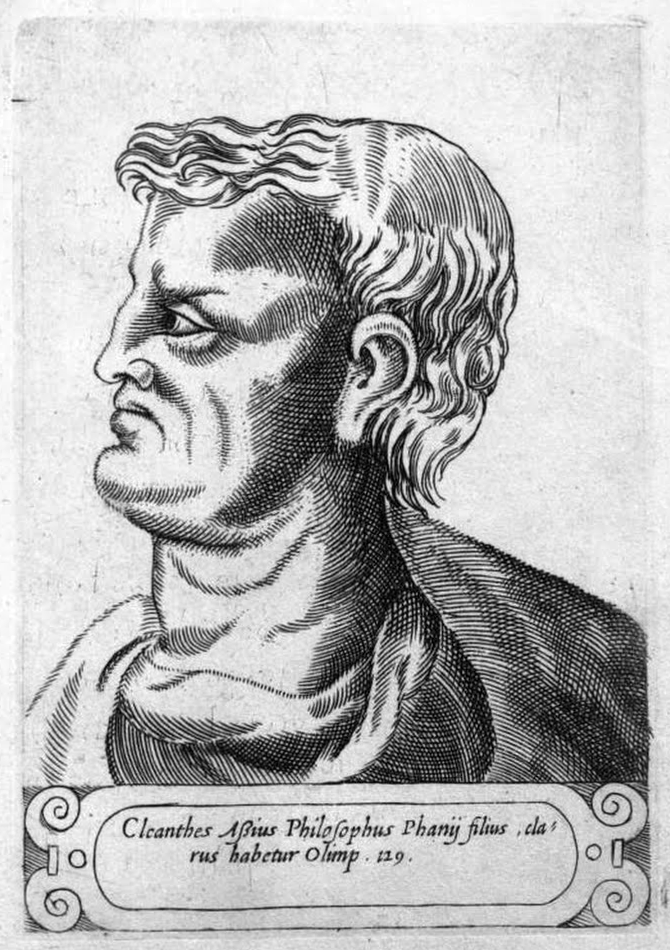
Κλεάνθης
c. 330 – c. 230 BC
Cleanthes of Assos, from Girolamo Olgiati, Illustrium philosophorum et sapientum effigies (Venice, 1580). Girolamo Olgiati · Public domain · Wikimedia Commons
Zeno's successor as head of the Stoa, a former boxer who supported himself as a water-carrier; author of the Hymn to Zeus.
Biography · editorial
Cleanthes came from Assos in the Troad. The ancient accounts say he arrived in Athens almost penniless, worked at night drawing water so that he could study with Zeno by day, and became known for his endurance and steadiness rather than quickness of mind.
He succeeded Zeno as head of the school around 262 BC and led it for about thirty years. He developed Stoic physics and theology, describing the world as a living whole governed by a divine reason and fire. His Hymn to Zeus, the longest piece of early Stoic writing to survive, is in the Library with the Greek.
A short verse prayer attributed to him, asking Zeus and Destiny to lead him willingly where he must go, was much quoted by later Stoics. Epictetus closes the Enchiridion with it (Enchiridion 53).
In the Library
Works
Ancient accounts of Cleanthes
Passages that mention Cleanthes
53 passages in 9 works, found by name in the English translations. This is a first-pass index: a few matches may be namesakes.
Lives of Eminent Philosophers, Book VII · 27
- Lives 7.14 — …in order that, for fear of being asked to give, people might desist from mobbing him, as Cleanthes says in his work On Bronze. When several persons stood about him in the Colonnade he…
- Lives 7.17 — …which of the two was the more impudent. Being enamoured of Chremonides, as he and Cleanthes were sitting beside the youth, he got up, and upon Cleanthes expressing surprise, Good…
- Lives 7.37 — …to call pain a thing indifferent: his native place was Heraclea; Sphaerus of Bosporus; Cleanthes, son of Phanias, of Assos, his successor in the school: him Zeno used to compare to hard…
- Lives 7.41 — …by Phanias, the pupil of Posidonius, in the first book of his Lectures of Posidonius. Cleanthes makes not three, but six parts, Dialectic, Rhetoric, Ethics, Politics, Physics,…
Show 23 more
- Lives 7.84 — …Diogenes, Antipater, and Posidonius, and their disciples. Zeno of Citium and Cleanthes treated the subject somewhat less elaborately, as might be expected in an older…
- Lives 7.87 — …same as a virtuous life, virtue being the goal towards which nature guides us. So too Cleanthes in his treatise On Pleasure, as also Posidonius, and Hecato in his work On Ends. Again,…
- Lives 7.89 — …understands both universal nature and more particularly the nature of man, whereas Cleanthes takes the nature of the universe alone as that which should be followed, without adding…
- Lives 7.91 — …can be taught is laid down by Chrysippus in the first book of his work On the End, by Cleanthes, by Posidonius in his Protreptica, and by Hecato; that it can be taught is clear from…
- Lives 7.92 — …while by the school of Posidonius four types are recognized, and more than four by Cleanthes, Chrysippus, Antipater, and their followers. Apollophanes for his part counts but one,…
- Lives 7.127 — …applies to the other virtues. Further, while Chrysippus holds that virtue can be lost, Cleanthes maintains that it cannot. According to the former it may be lost in consequence of…
- Lives 7.128 — …and strength. Another tenet of theirs is the perpetual exercise of virtue, as held by Cleanthes and his followers. For virtue can never be lost, and the good man is always exercising…
- Lives 7.134 — …of matter. This doctrine is laid down by Zeno of Citium in his treatise On Existence, Cleanthes in his work On Atoms, Chrysippus in the first book of his Physics towards the end,…
- Lives 7.139 — …his work On Providence and Posidonius in his book On the Gods say that the heaven, but Cleanthes that the sun, is the ruling power of the world. Chrysippus, however, in the course of…
- Lives 7.142 — …first book of his Physics, by Posidonius in the first book of his work On the Cosmos, by Cleanthes, and by Antipater in his tenth book On the Cosmos. Panaetius, however, maintained that…
- Lives 7.157 — …the soul as a warm breath; for by this we become animate and this enables us to move. Cleanthes indeed holds that all souls continue to exist until the general conflagration; but…
- Lives 7.163 — …to the Counter-pleas of Alexinus. Against the Dialecticians, three books. Letters to Cleanthes, four books. Panaetius and Sosicrates consider the Letters to be alone genuine; all the…
- Lives 7.167 — …three, then, are the heterodox Stoics. The legitimate successor to Zeno, however, was Cleanthes: of whom we have now to speak.
- Lives 7.168 — Cleanthes, son of Phanias, was a native of Assos. This man, says Antisthenes in his Successions of…
- Lives 7.170 — And one day he produced a handful of small coin before his acquaintance and said, Cleanthes could even maintain a second Cleanthes, if he liked, whereas those who possess the means…
- Lives 7.171 — …events by his deeds. And Arcesilaus rejoined, I am not to be won by flattery. Whereupon Cleanthes said, True, but my flattery consists in alleging that your theory is incompatible with…
- Lives 7.172 — When some one inquired of him what lesson he ought to give his son, Cleanthes in reply quoted words from the Electra: Silence, silence, light be thy step. A…
- Lives 7.173 — He was present in the theatre when the poet Sositheus uttered the verse— Driven by Cleanthes’ folly like dumb herds, and he remained unmoved in the same attitude. At which the…
- Lives 7.176 — …spent nineteen years as Zeno’s pupil. My lighter verse on him runs thus: I praise Cleanthes, but praise Hades more, Who could not bear to see him grown so old, So gave him rest at…
- Lives 7.177 — Amongst those who after the death of Zeno became pupils of Cleanthes was Sphaerus of Bosporus, as already mentioned. After making considerable progress in…
- Lives 7.179 — …from Soli or from Tarsus, as Alexander relates in his Successions. He was a pupil of Cleanthes. Before this he used to practise as a long-distance runner; but afterwards he came to…
- Lives 7.182 — …I should not have studied philosophy. When some dialectician got up and attacked Cleanthes, proposing sophistical fallacies to him, Chrysippus called to him, Cease to distract…
- Lives 7.185 — …judgement, says Demetrius in his work called Men of the Same Name. When Ptolemy wrote to Cleanthes requesting him to come himself or else to send some one to his court, Sphaerus undertook…
Moral Letters to Lucilius · 10
- Letters 6.6 — Cleanthes could not have been the express image of Zeno, if he had merely heard his lectures; he…
- Letters 33.4 — …out each separate motto from the general stock; to whom shall we credit them? To Zeno, Cleanthes, Chrysippus, Panaetius, or Posidonius? We Stoics are not subjects of a despot: each of…
- Letters 33.7 — …“This is what Zeno said.” But what have you yourself said? “This is the opinion of Cleanthes.” But what is your own opinion? How long shall you march under another man’s orders?…
- Letters 33.9 — “Thus said Zeno, thus said Cleanthes, indeed!” Let there be a difference between yourself and your book! How long shall you…
Show 6 more
- Letters 44.3 — Socrates was no aristocrat. Cleanthes worked at a well and served as a hired man watering a garden. Philosophy did not find…
- Letters 64.10 — …Marcus Cato, the Elder and the Younger, Laelius the Wise, Socrates and Plato, Zeno and Cleanthes? I worship them in very truth, and always rise to do honour to such noble names.…
- Letters 94.4 — Cleanthes holds that this department of wisdom is indeed useful, but that it is a feeble thing…
- Letters 107.10 — …are woven. Let us address Jupiter, the pilot of this world-mass, as did our great Cleanthes in those most eloquent lines—lines which I shall allow myself to render in Latin, after…
- Letters 108.10 — Cleanthes used to say: “As our breath produces a louder sound when it passes through the long and…
- Letters 113.23 — …I am the first one of our school who does not speak from rules but has his own opinion: Cleanthes and his pupil Chrysippus could not agree in defining the act of walking. Cleanthes held…
Discourses · 6
- Discourses 1.17 — …and weighs all other Things. Who says this? Is it only Chrysippus, and Zeno, and Cleanthes? And doth not Antisthenes say it? And who is it, then, who has written, That the…
- Discourses 2.19 — …and, consequently, assert, That not every thing past is necessarily true. This Way Cleanthes and his Followers, took; whom Antipater copiously defends. Others, lastly, maintain the…
- Discourses 3.23 — …you are uttering little Exclamations? Was this the Practice of Socrates? Of Zeno? Of Cleanthes? "What then! is there not in speaking, a Style and Manner of Exhortation?"——Who denies…
- Discourses 3.26 — …Philosophers; how Socrates lived, even with a wife and Children; how, Diogenes; how, Cleanthes, at once studying and drawing Water. If these are the Things you would have, you will…
Show 2 more
- Discourses 4.1 — …Palace, you will be never the less so. And you will feel, that though Philosophers (as Cleanthes says) do, perhaps, talk contrary to common Opinion, yet not contrary to Reason. For you…
- Discourses 4.4 — …to Restraint, to Compulsion; you are altogether the Property of others. But have that of Cleanthes always ready, Conduct me, Jove; and Thou, O Destiny. Is it Your Will, that I should go…
On Benefits · 3
- On Benefits 5.14 — Cleanthes speaks more impetuously than this. "Granted," says he, "that what he received was not a…
- On Benefits 6.11 — Cleanthes makes use of the following example:--"I sent," says he, "two slaves to look for Plato…
- On Benefits 6.12 — …a school of arms, who takes great pains in exercising and equipping his gladiators. As Cleanthes says, there is a great difference between benefits and trade.
On Stoic Self-Contradictions · 3
- Plutarch, On Stoic Self-Contradictions 2 — Since then there are in their discourses many things written by Zeno himself, many by Cleanthes, and most of all by Chrysippus, concerning policy, governing, and being governed,…
- Plutarch, On Stoic Self-Contradictions 4 — Indeed Antipater, in his writings concerning the difference between Cleanthes and Chrysippus, has related that Zeno and Cleanthes would not be made citizens of…
- Plutarch, On Stoic Self-Contradictions 7 — …virtue, and yet defends Zeno, who in this manner defines every one of the virtues. And Cleanthes, having in his Commentaries concerning Nature said, that vigor is the striking of fire,…
Life of Cato the Younger · 1
- Plutarch, Cato Minor 70 — …those outside the chamber heard him. But about midnight he called two of his freedmen, Cleanthes the physician, and Butas, who was his chief agent in public matters. Butas he sent down…
Against the Stoics on Common Conceptions · 1
- Plutarch, On Common Conceptions 31 — …subsistence of an incorruptibility, but keeping the idea of a God. But Chrysippus and Cleanthes, having filled (as one may say) heaven, earth, air, and sea with Gods, have not yet made…
On Leisure · 1
- On Leisure 6 — …all men of all nations, both now and hereafter? To sum up the matter, I ask you whether Cleanthes, Chrysippus, and Zeno lived in accordance with their doctrine? I am sure that you will…
Satires · 1
- Persius, Satire 5 — …to grow pale over nightly study, to till the minds of the young, and to sow the seed of Cleanthes in their well-cleansed ears. Seek thence all of you, young men and old alike, a sure aim…