Early Stoa
Zeno of Citium
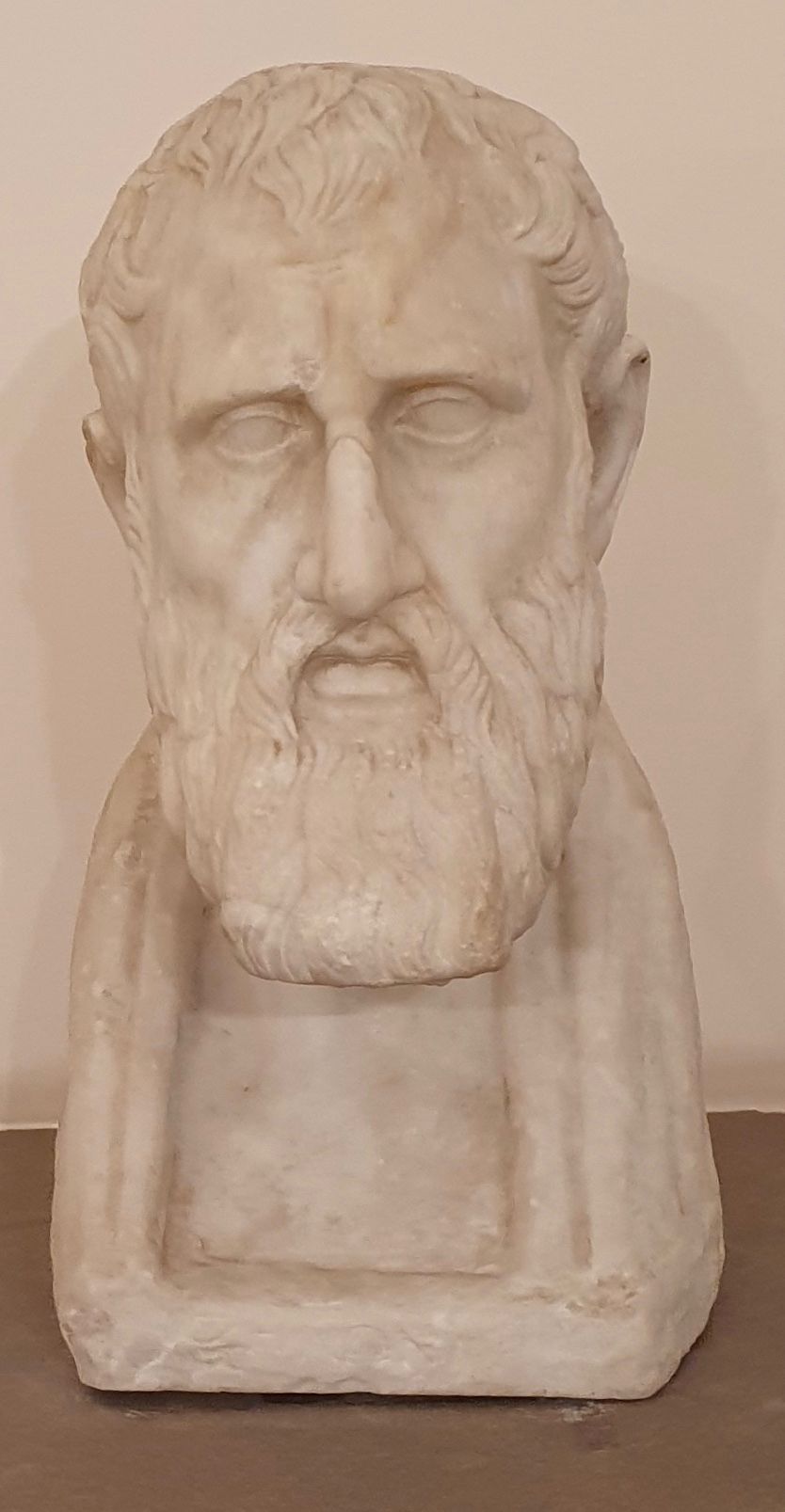
Ζήνων ὁ Κιτιεύς
c. 334 – c. 262 BC
Bust of Zeno of Citium, Farnese collection, National Archaeological Museum of Naples. Photo: Yair-haklai · CC BY-SA 4.0 · Wikimedia Commons
Founder of Stoicism, who taught in the Painted Stoa at Athens from about 300 BC.
Biography · editorial
Zeno came to Athens from Citium in Cyprus. Diogenes Laërtius preserves the story that he arrived after a shipwreck, read about Socrates in a bookshop and asked where such men could be found, and was pointed towards the Cynic Crates. He went on to study with Stilpo and with the Platonist Polemo before beginning to teach on his own.
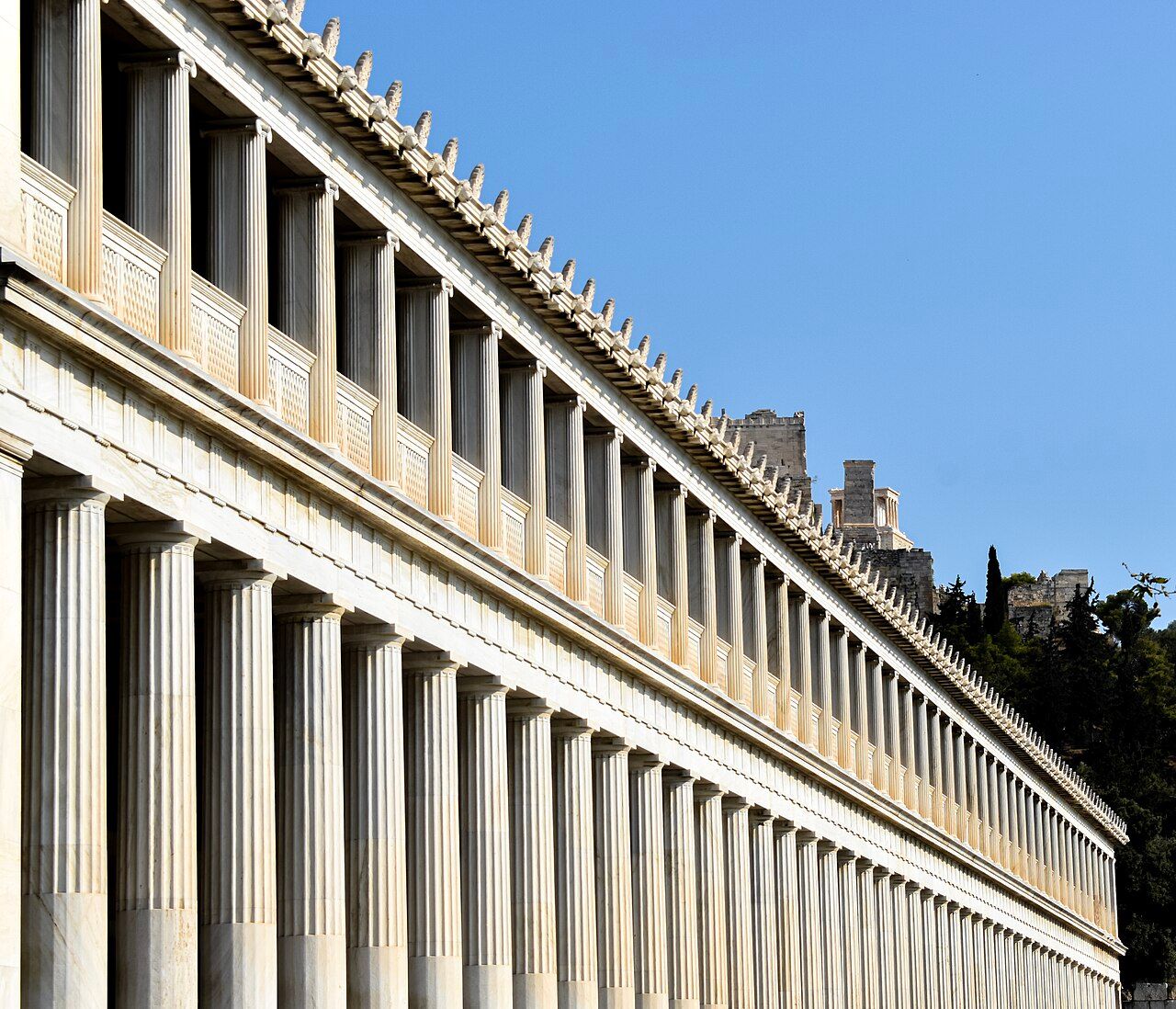
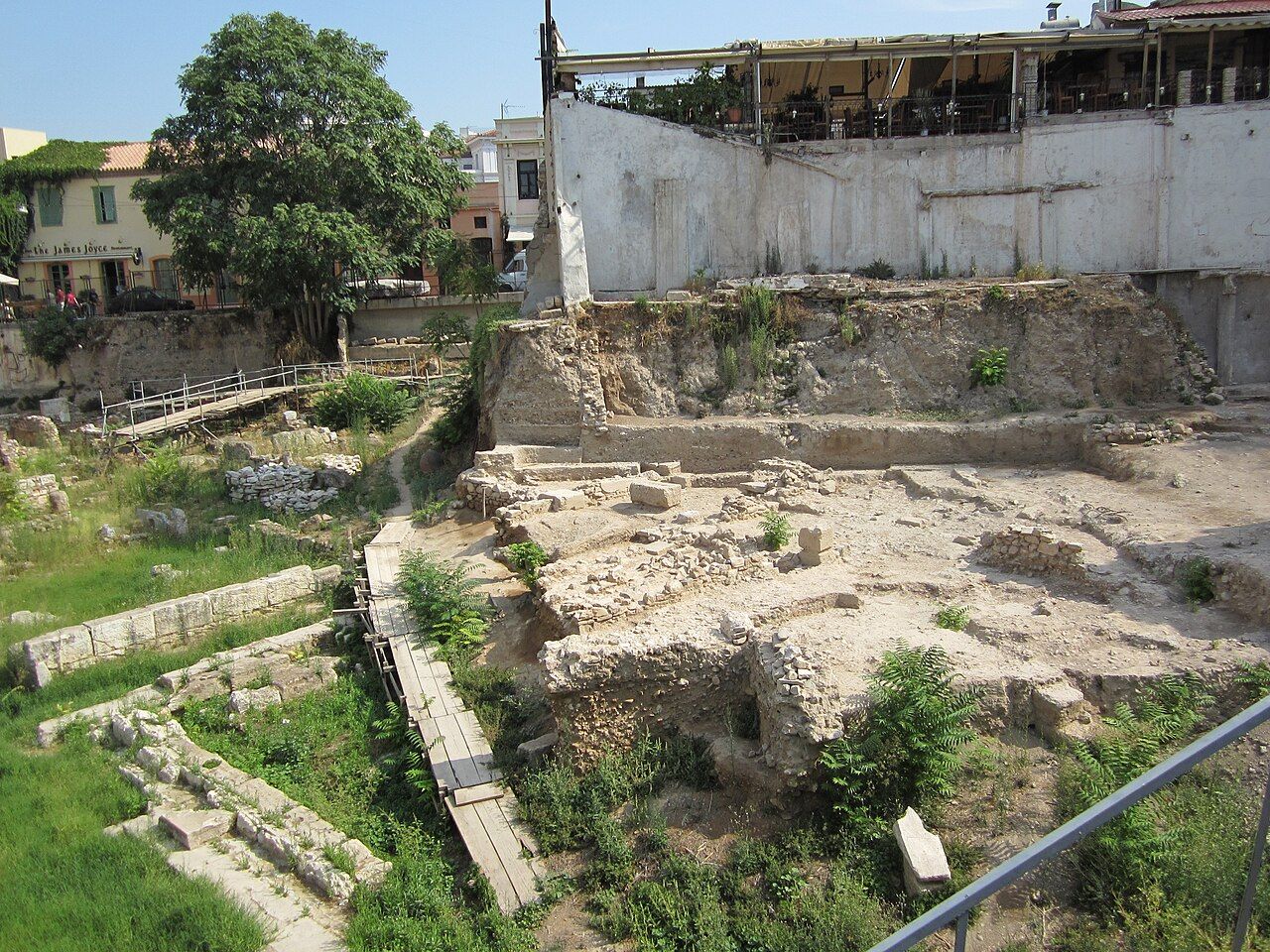
Around 300 BC he started lecturing in the Stoa Poikile, the Painted Colonnade on the edge of the Athenian agora. His followers were first called Zenonians and then, after the place, Stoics. Athens later honoured him for the example of his life.
His writings are lost, but the reports of them in Diogenes Laërtius’ Lives Book VII and elsewhere show the outline of the system: philosophy divided into logic, physics and ethics; a world ordered by divine reason; and the human goal of living in agreement with nature, which is the same as living virtuously. His early Republic imagined a community of the wise without temples, courts or money.
In the Library
Ancient accounts of Zeno of Citium
In art and archaeology
Passages that mention Zeno of Citium
116 passages in 15 works, found by name in the English translations. This is a first-pass index: a few matches may be namesakes.
Lives of Eminent Philosophers, Book VII · 70
- Lives 7.1 — Zeno, the son of Mnaseas (or Demeas), was a native of Citium in Cyprus, a Greek city which…
- Lives 7.2 — …Polemo as well. It is stated by Hecato and by Apollonius of Tyre in his first book on Zeno that he consulted the oracle to know what he should do to attain the best life, and that…
- Lives 7.3 — …ashamed and tried to keep it out of sight, with a blow of his staff he broke the pot. As Zeno took to flight with the lentil-soup flowing down his legs, Why run away, my little…
- Lives 7.5 — …Athenian citizens had been put to death. Hither, then, people came henceforth to hear Zeno, and this is why they were known as men of the Stoa, or Stoics; and the same name was…
Show 66 more
- Lives 7.6 — The people of Athens held Zeno in high honour, as is proved by their depositing with him the keys of the city walls,…
- Lives 7.7 — King Antigonus to Zeno the philosopher, greeting. While in fortune and fame I deem myself your superior, in…
- Lives 7.8 — Zeno to King Antigonus, greeting. I welcome your love of learning in so far as you cleave to…
- Lives 7.10 — …the question to the vote; Thraso, the son of Thraso of the deme Anacaea, moved: Whereas Zeno of Citium, son of Mnaseas, has for many years been devoted to philosophy in the city and…
- Lives 7.11 — it has seemed good to the people— and may it turn out well—to bestow praise upon Zeno of Citium, the son of Mnaseas, and to crown him with a golden crown according to the…
- Lives 7.12 — …to the restoration of the baths and his name was inscribed upon the pillar as Zeno the philosopher, he requested that the words of Citium should be added. He made a hollow…
- Lives 7.13 — …a noisy party, and once took him along with other revellers to Aristocles the musician; Zeno, however, in a little while gave them the slip.
- Lives 7.14 — …write for anything he wanted to Antigonus, who would be sure to grant all his requests, Zeno after hearing this would have nothing more to do with him.
- Lives 7.15 — After Zeno’s death Antigonus is reported to have said, What an audience I have lost. Hence too he…
- Lives 7.16 — He used to dispute very carefully with Philo the logician and study along with him. Hence Zeno, who was the junior, had as great an admiration for Philo as his master Diodorus. And he…
- Lives 7.17 — When he was slowly picking his way across a watercourse, With good reason, quoth Zeno, he looks askance at the mud, for he can’t see his face in it. When a certain Cynic…
- Lives 7.19 — …greedy that he left nothing for his table companions. A large fish having been served, Zeno took it up as if he were about to eat the whole. When the other looked at him, What do…
- Lives 7.20 — …said that he thought the chainarguments of the philosophers seemed brief and curt, Zeno replied, You are quite right; indeed, the very syllables ought, if possible, to be…
- Lives 7.22 — …more, insisted on joining his class; but so unwelcome was this pupil, that first of all Zeno made him sit on the benches that were dusty, that he might soil his cloak, and then he…
- Lives 7.23 — …when the latter pleaded that it was his fate to steal, Yes, and to be beaten too, said Zeno. Beauty he called the flower of chastity, while according to others it was chastity…
- Lives 7.24 — …of Tyre tells us how, when Crates laid hold on him by the cloak to drag him from Stilpo, Zeno said, The right way to seize a philosopher, Crates, is by the ears: persuade me then and…
- Lives 7.25 — …was he. In consequence Polemo is said to have addressed him thus: You slip in, Zeno, by the garden door—I’m quite aware of it—you filch my doctrines and give them a…
- Lives 7.27 — …this time he had almost become a proverb. At all events, More temperate than Zeno the philosopher was a current saying about him. Poseidippus also writes in his Men…
- Lives 7.29 — …goodness. Here is the epitaph composed for him by Antipater of Sidon: Here lies great Zeno, dear to Citium, who scaled high Olympus, though he piled not Pelion on Ossa, nor toiled…
- Lives 7.30 — …of Diogenes: Thou madest self-sufficiency thy rule, Eschewing haughty wealth, O godlike Zeno, With aspect grave and hoary brow serene. A manly doctrine thine: and by thy…
- Lives 7.31 — We have ourselves mentioned the manner of Zeno’s death in the Pammetros (a collection of poems in various metres): The story goes that…
- Lives 7.32 — …And it seems, he adds, that, when the rest were at a loss how to express their views, Zeno framed a definition of the end. They say that he was in the habit of swearing by capers…
- Lives 7.34 — That the Republic is the work of Zeno is attested by Chrysippus in his De Republica. And he discussed amatory subjects in the…
- Lives 7.35 — There have been eight persons of the name of Zeno. First the Eleatic, of whom more hereafter; the second our present subject; the third a…
- Lives 7.36 — Of the many disciples of Zeno the following are the most famous: Persaeus, son of Demetrius, of Citium, whom some call…
- Lives 7.37 — …of Bosporus; Cleanthes, son of Phanias, of Assos, his successor in the school: him Zeno used to compare to hard waxen tablets which are difficult to write upon, but retain the…
- Lives 7.38 — And furthermore the following according to Hippobotus were pupils of Zeno: Philonides of Thebes; Callippus of Corinth; Posidonius of Alexandria; Athenodorus of…
- Lives 7.39 — …Stoics, falls into three parts: one physical, another ethical, and the third logical. Zeno of Citium was the first to make this division in his Exposition of Doctrine, and…
- Lives 7.40 — …with Logic, go on to Physics, and finish with Ethics; and among those who so do are Zeno in his treatise On Exposition, Chrysippus, Archedemus and Eudromus.
- Lives 7.84 — …Zeno of Tarsus, Apollodorus, Diogenes, Antipater, and Posidonius, and their disciples. Zeno of Citium and Cleanthes treated the subject somewhat less elaborately, as might be…
- Lives 7.87 — This is why Zeno was the first (in his treatise On the Nature of Man) to designate as the end life in…
- Lives 7.108 — Zeno was the first to use this term καθῆκον of conduct. Etymologically it is derived from…
- Lives 7.110 — …or emotions, which are causes of instability. Passion, or emotion, is defined by Zeno as an irrational and unnatural movement in the soul, or again as impulse in excess. The…
- Lives 7.120 — …so Chrysippus in the fourth book of his Ethical Questions, as well as Persaeus and Zeno. For if one truth is not more true than another, neither is one falsehood more false…
- Lives 7.121 — …thus he will restrain vice and promote virtue. Also (they maintain) he will marry, as Zeno says in his Republic, and beget children. Moreover, they say that the wise man will…
- Lives 7.122 — …rule, which none but the wise can maintain: so Chrysippus in his treatise vindicating Zeno’s use of terminology. For he holds that knowledge of good and evil is a necessary…
- Lives 7.127 — …Moreover, they hold that it is in itself sufficient to ensure well-being: thus Zeno, and Chrysippus in the first book of his treatise On Virtues, and Hecato in the second…
- Lives 7.129 — …for the youths who by their countenance show a natural endowment for virtue. So Zeno in his Republic, Chrysippus in book i. of his work On Modes of Life, and Apollodorus in…
- Lives 7.131 — …amongst the wise there should be a community of wives with free choice of partners, as Zeno says in his Republic and Chrysippus in his treatise On Government [and not only they,…
- Lives 7.134 — …each several thing throughout the whole extent of matter. This doctrine is laid down by Zeno of Citium in his treatise On Existence, Cleanthes in his work On Atoms, Chrysippus in…
- Lives 7.136 — …created first of all the four elements, fire, water, air, earth. They are discussed by Zeno in his treatise On the Whole, by Chrysippus in the first book of his Physics, and by…
- Lives 7.142 — …by their mixture. The generation and the destruction of the world are discussed by Zeno in his treatise On the Whole, by Chrysippus in the first book of his Physics, by…
- Lives 7.143 — …denies that the world is a living thing. The unity of the world is maintained by Zeno in his treatise On the Whole, by Chrysippus, by Apollodorus in his Physics, and by…
- Lives 7.145 — …sun takes place when the moon passes in front of it on the side towards us, as shown by Zeno with a diagram in his treatise On the Whole.
- Lives 7.148 — The substance of God is declared by Zeno to be the whole world and the heaven, as well as by Chrysippus in his first book Of the…
- Lives 7.149 — …by Chrysippus in his treatise De fato, by Posidonius in his De fato, book ii., by Zeno and by Boëthus in his De fato, book i. Fate is defined as an endless chain of causation,…
- Lives 7.150 — …make the substratum of all things: so Chrysippus in the first book of his Physics, and Zeno. By matter is meant that out of which anything whatsoever is produced. Both substance…
- Lives 7.153 — …Lightning is a kindling of clouds from being rubbed together or being rent by wind, as Zeno says in his treatise On the Whole; thunder the noise these clouds make when they rub…
- Lives 7.157 — Zeno of Citium and Antipater, in their treatises De anima, and Posidonius define the soul as…
- Lives 7.161 — …artistic workmanship, are yet of no use. He would not admit a plurality of virtues with Zeno, nor again with the Megarians one single virtue called by many names; but he treated…
- Lives 7.162 — After meeting Polemo, says Diocles of Magnesia, while Zeno was suffering from a protracted illness, he recanted his views. The Stoic doctrine to…
- Lives 7.163 — …eyesight? The books attributed to him are as follows: Exhortations, two books. Of Zeno’s Doctrines. Dialogues. Lectures, six books. Dissertations on Philosophy, seven…
- Lives 7.165 — …much space, are full of vigour and contain some controversial passages in reply to Zeno.
- Lives 7.166 — He is said to have had many admirers when a boy; and as Zeno wished to drive them away, he compelled Herillus to have his head shaved, which…
- Lives 7.167 — …he took Aratus for his model, whom he strove to imitate. When he fell away from Zeno, he went over to the Cyrenaics, and used to frequent houses of ill fame and indulge in…
- Lives 7.168 — …He arrived in Athens, as some people say, with four drachmas only, and meeting with Zeno he studied philosophy right nobly and adhered to the same doctrines throughout. He was…
- Lives 7.169 — …to crush. The Areopagites were satisfied and voted him a donation of ten minas, which Zeno forbade him to accept. We are also told that Antigonus made him a present of three…
- Lives 7.170 — …being called the ass, telling them that he alone was strong enough to carry the load of Zeno.
- Lives 7.173 — …give forth sweet sounds, never hear themselves. It is said that when he laid it down as Zeno’s opinion that a man’s character could be known from his looks, certain witty young men…
- Lives 7.174 — …that I can still write and read, I am content to wait. We are told that he wrote down Zeno’s lectures on oyster-shells and the blade-bones of oxen through lack of money to buy…
- Lives 7.176 — …on the road, he went on fasting the rest of his days until his death at the same age as Zeno according to some authorities, having spent nineteen years as Zeno’s pupil. My lighter…
- Lives 7.177 — Amongst those who after the death of Zeno became pupils of Cleanthes was Sphaerus of Bosporus, as already mentioned. After making…
- Lives 7.179 — …this he used to practise as a long-distance runner; but afterwards he came to hear Zeno, or, as Diocles and most people say, Cleanthes; and then, while Cleanthes was still…
- Lives 7.189 — …addressed to Metrodorus, six books. On the Terms used in Dialectic, addressed to Zeno, one book.
- Lives 7.195 — Second series: On Conclusive Arguments, addressed to Zeno, one book. On the Primary Indemonstrable Syllogisms, addressed to Zeno, one book. On the…
- Lives 7.201 — …the Ancients rightly admitted Dialectic as well as Demonstration, addressed to Zeno, two books.
Moral Letters to Lucilius · 15
- Letters 6.6 — Cleanthes could not have been the express image of Zeno, if he had merely heard his lectures; he shared in his life, saw into his hidden…
- Letters 22.11 — …annoyance,—how can the whole company of Stoic thinkers fail to approve your course? Zeno, Chrysippus, and all their kind will give you advice that is temperate, honourable, and…
- Letters 33.4 — …to sort out each separate motto from the general stock; to whom shall we credit them? To Zeno, Cleanthes, Chrysippus, Panaetius, or Posidonius? We Stoics are not subjects of a…
- Letters 33.7 — …an old man, or one who has sighted old age, to have a note-book knowledge. “This is what Zeno said.” But what have you yourself said? “This is the opinion of Cleanthes.” But what is…
Show 11 more
- Letters 33.9 — “Thus said Zeno, thus said Cleanthes, indeed!” Let there be a difference between yourself and your book!…
- Letters 64.10 — …of respect Marcus Cato, the Elder and the Younger, Laelius the Wise, Socrates and Plato, Zeno and Cleanthes? I worship them in very truth, and always rise to do honour to such noble…
- Letters 82.9 — Our master Zeno uses a syllogism like this: “No evil is glorious; but death is glorious; therefore death…
- Letters 82.19 — …to advance like a soldier. Those of our school, it is true, would have men think that Zeno’s syllogism is correct, but that the second I mentioned, which is set up against his, is…
- Letters 83.9 — Zeno, that greatest of men, the revered founder of our brave and holy school of philosophy,…
- Letters 83.10 — Posidonius pleads the cause of our master Zeno in the only possible way; but it cannot, I hold, be pleaded even in this way. For…
- Letters 83.11 — …of the careful use of words, and who weighs his language. Moreover, if this is what Zeno meant, and what he wished it to mean to us, he was trying to avail himself of an…
- Letters 83.17 — …freely. Therefore this proposition, which is laid down in the guise of a defence of Zeno’s syllogism, is false,—that secrets are not entrusted to the habitual drunkard. How…
- Letters 88.45 — …everything is unsure; if with Parmenides, there is nothing except the One; if with Zeno, there is not even the One.
- Letters 104.21 — …Tubero. Or, if you enjoy living with Greeks also, spend your time with Socrates and with Zeno: the former will show you how to die if it be necessary; the latter how to die before it…
- Letters 108.38 — They have been spoken by Plato, spoken by Zeno, spoken by Chrysippus or by Posidonius, and by a whole host of Stoics as numerous as…
Discourses · 8
- Discourses 1.17 — …may say, measures and weighs all other Things. Who says this? Is it only Chrysippus, and Zeno, and Cleanthes? And doth not Antisthenes say it? And who is it, then, who has written,…
- Discourses 1.20 — …Doctrine of the Philosophers, of itself, is short. If you have a mind to know it, read Zeno, and you will see. For what Prolixity is there in saying, Our End is to follow the Gods?…
- Discourses 2.13 — …stare; With chatt'ring Teeth be stands, and stiffen'd Hair. Pope's Homer. Therefore Zeno, when he was to meet Antigonus, felt no Solicitude. For over what he admired, Antigonus…
- Discourses 3.21 — …to undertake the Office of Confutation; Diogenes, that of authoritative Reproof; Zeno, that of dogmatical Instruction. But you set up for a Physician, provided with nothing…
Show 4 more
- Discourses 3.23 — …you, while you are uttering little Exclamations? Was this the Practice of Socrates? Of Zeno? Of Cleanthes? "What then! is there not in speaking, a Style and Manner of…
- Discourses 3.24 — …follow their Practices, and hold their Principles, do you talk to us of the Doctrines of Zeno and Socrates? Why do not you throw away, to as great a Distance as possible, those…
- Discourses 4.8 — …are his Theorems? Are they how to get a great Beard, or long Hair?——No: but rather, as Zeno expresses it, To know the Elements of Reason, what each of them is in particular, and…
- Discourses 4.9 — …were modest, Man, and are so no longer. Have you lost nothing? Instead of Chrysippus and Zeno, you read Aristides and Euenus. Have you lost nothing then? Instead of Socrates and…
On Stoic Self-Contradictions · 7
- Plutarch, On Stoic Self-Contradictions 2 — Since then there are in their discourses many things written by Zeno himself, many by Cleanthes, and most of all by Chrysippus, concerning policy, governing,…
- Plutarch, On Stoic Self-Contradictions 4 — …writings concerning the difference between Cleanthes and Chrysippus, has related that Zeno and Cleanthes would not be made citizens of Athens, lest they might seem to injure their…
- Plutarch, On Stoic Self-Contradictions 6 — It is moreover a doctrine of Zeno’s, that temples are not to be built to the Gods; for that a temple is neither a thing of…
- Plutarch, On Stoic Self-Contradictions 7 — Moreover, Zeno admits (as Plato does) several virtues with various distinctions—to wit, prudence,…
Show 3 more
- Plutarch, On Stoic Self-Contradictions 8 — Against him, who said, Give not thy judgment till both sides are heard, Zeno on the contrary made use of such an argument as this: If he who spake first has plainly…
- Plutarch, On Stoic Self-Contradictions 30 — Some of the ancients have said, that the same befell Zeno which befalls him who has sour wine which he can sell neither for vinegar nor wine; for…
- Plutarch, On Stoic Self-Contradictions 37 — …he was yet living, by the Cyloneans, the putting to death—and that with torture—of Zeno by the tyrant Demylus, and of Antiphon by Dionysius, with the letting of bran fall. But…
On Ends, Book III · 3
- De Finibus 3.4 — …there is no school of philosophers which has made so many innovations as the Stoics. Zeno too, their chief, was not so much a discoverer of new things as of new words. But if,…
- De Finibus 3.12 — …time, explain to you, unless you think it foreign to the subject, the whole opinion of Zeno and the Stoics on the matter. Very far from foreign to the subject, said I; indeed, your…
- De Finibus 3.48 — …and things like them, and some had not. And thus, from this distinction, came what Zeno called προηγμένον, and on the other hand what he called ἀποπροηγμένον, as though writing…
On Leisure · 3
- On Leisure 1 — …when we are dying. Why do you preach the maxims of Epicurus in the very headquarters of Zeno? nay, if you are ashamed of your party, why do you not go openly altogether over to the…
- On Leisure 3 — …that I have laid any commandment upon myself to do nothing contrary to the teaching of Zeno and Chrysippus, but because the matter itself allows me to follow the precepts of those…
- On Leisure 6 — …by which he will be of service to posterity. Our school at any rate declares that Zeno and Chrysippus have done greater things than they would have done had they been in…
On Benefits · 2
- On Benefits 4.39 — "Why then," argues our adversary, "did your Stoic philosopher Zeno, when he had promised a loan of five hundred denarii to some person, whom he afterwards…
- On Benefits 7.8 — …of everything of which you speak. I will not remind you of Socrates, Chrysippus, Zeno, and other great men, all the greater, however, because envy prevents no one from…
Attic Nights (selection) · 1
- Gellius, Attic Nights 19.1 — …Epictetus, which, as arranged by Arrian, undoubtedly agree with the writings of Zeno and Chrysippus. In that book I read this statement, which of course was written in…
Against the Stoics on Common Conceptions · 1
- Plutarch, On Common Conceptions 23 — …and Theophrastus begin? What beginnings do Xenocrates and Polemo take? Does not also Zeno follow these, who suppose Nature and that which is according to Nature to be the…
Consolation to Helvia · 1
- Consolation to Helvia 12 — …of old. It is well known that Homer had one slave, that Plato had three, and that Zeno, who first taught the stern and masculine doctrine of the Stoics, had none: yet could…
On Duties · 1
- De Officiis 3.35 — …we are born for moral rectitude and if that is either the only thing worth seeking, as Zeno thought, or at least to be esteemed as infinitely outweighing everything else, as…
Enchiridion · 1
- Enchiridion 33 — …and especially with one who seems your superior, represent to yourself how Socrates or Zeno would behave in such a case, and you will not be at a loss to meet properly whatever may…
On Anger · 1
- On Anger 1.16 — …wont?" I admit that it will: he will experience a slight and trifling emotion; for, as Zeno says, "Even in the mind of the wise man, a scar remains after the wound is quite…
On Peace of Mind · 1
- On Peace of Mind 14 — …to itself; let it not feel losses, and put a good construction even upon misfortunes. Zeno, the chief of our school, when he heard the news of a shipwreck, in which all his…
On the Happy Life · 1
- On the Happy Life 18 — …bitterest hatred to the best of men, this reproach was flung at Plato, at Epicurus, at Zeno: for all these declared how they ought to live, not how they did live. I speak of…