Roman Stoa
Epictetus
Ἐπίκτητος
c. AD 50 – c. AD 135
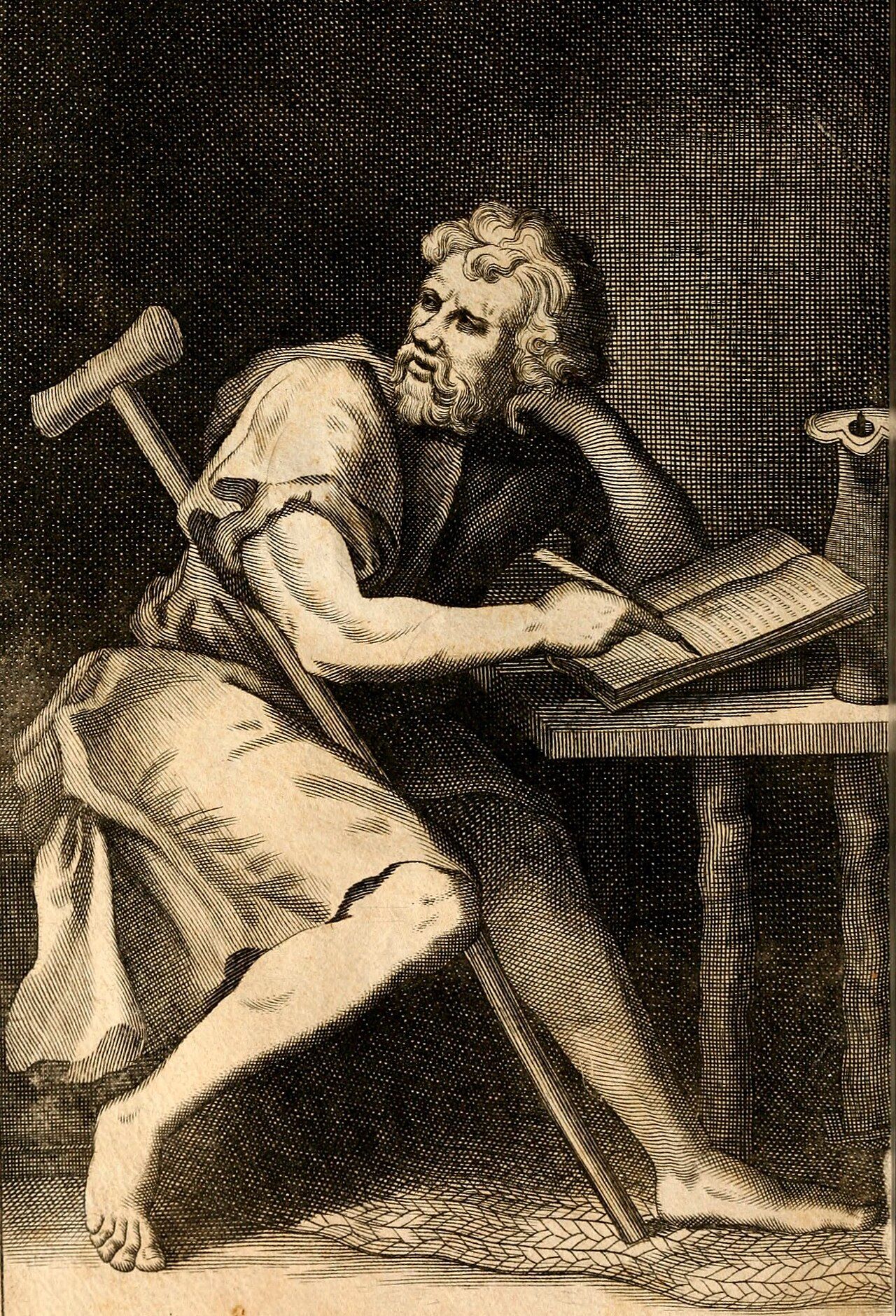
Imaginary portrait of Epictetus, engraved frontispiece to Edward Ivie's Latin verse Enchiridion (Oxford, 1715). William Sonmans / Michael Burghers · Public domain · Wikimedia Commons
Former slave who became the most influential Stoic teacher of the Roman empire, teaching at Nicopolis after Domitian expelled the philosophers from Rome.
Biography · editorial
Epictetus was born a slave at Hierapolis in Phrygia and belonged to Epaphroditus, a powerful freedman at Nero’s court. He was allowed to study with Musonius Rufus and was later freed. He was lame, whether from birth or from mistreatment the sources disagree.
He taught in Rome until the emperor Domitian expelled the philosophers from Italy around AD 93, then opened a school at Nicopolis in western Greece, which drew students from across the empire. He wrote nothing himself. His student Arrian took notes of his talks and published them as the Discourses, along with a short digest, the Enchiridion.
His teaching centres on one distinction: some things are up to us and others are not. Our judgements, choices and desires are our own; body, property, reputation and office are not. Freedom and peace come from caring only about what is ours to control. Marcus Aurelius read him and thanks Junius Rusticus for introducing him to the Discourses (Meditations 1.7).
In the Library
Works
Ancient accounts of Epictetus
Passages that mention Epictetus
40 passages in 4 works, found by name in the English translations. This is a first-pass index: a few matches may be namesakes.
Discourses · 23
- Discourses 1.1 — …Respects, we should not be hindered by Things without us? But what says Jupiter? "O Epictetus, if it were possible, I had made this little Body and Property of thine free, and not…
- Discourses 1.2 — …asked, whether he acted thus as a Wrestler, or a Philosopher? I answer, As a Man, said Epictetus; but as a Man who had been proclaimed a Champion at the Olympic Games; who had been used…
- Discourses 1.5 — If a man, said Epictetus, opposes evident truths, it is not easy to find arguments by which we shall make him…
- Discourses 1.9 — …employ your Master and Preceptor, if you had one that you should come to him, and say; "Epictetus, we can no longer bear being tied down to this paultry Body: feeding and resting, and…
Show 19 more
- Discourses 1.10 — …to Court, you will go in, heartily rejoiced, and thank God. "If you ever find me, Epictetus, said he, putting one Foot into the Court, think of me whatever you please." Now, after…
- Discourses 1.11 — When one of the great Men came to visit him, Epictetus, having inquired into the Particulars of his Affairs, asked him, Whether he had a Wife…
- Discourses 1.13 — …inquired, How any one might eat acceptably to the Gods: if he eats with Justice, says Epictetus, and Gratitude; and fairly and temperately, and decently, must he not also eat…
- Discourses 1.14 — …that each of his Actions are under the Inspection of God? Do not you think, says Epictetus, that all Things are mutually bound together and united? I do. Well: and do not you…
- Discourses 1.15 — …him, How he might persuade his Brother to forbear treating him ill: Philosophy, answered Epictetus, doth not promise to procure any thing external to Man; otherwise it would admit…
- Discourses 1.26 — …his Scholars] was reading hypothetical Syllogisms; it is likewise a Law in these, says Epictetus, to admit what follows from the Hypothesis: but much more is it a Law in Life, to do…
- Discourses 1.28 — …have the absurdities of the sceptics confuted and guarded against by regular argument. Epictetus allows this to be right, for such as have abilities and leisure; but recommends in…
- Discourses 2.4 — …happened to come in, who had been found guilty of Adultery, in that City. But, continues Epictetus, if, laying aside that Fidelity for which we were born, we form Designs against the Wife…
- Discourses 2.14 — When a certain Roman came to him with his Son, and had heard one Lesson, This, said Epictetus, is the Method of Teaching; and stopt. When the other desired him to go on; Every Art,…
- Discourses 2.18 — …as undress'd, as lying down beside me." On this I stroak my Head, and say, Well done, Epictetus; thou hast solved a pretty Sophism, a much prettier than one very celebrated in the…
- Discourses 2.22 — …your father? You fain would still behold it. Would not he? The second line, as quoted by Epictetus, is not found in the received editions. Pheres, the father of Admetus, is defending…
- Discourses 2.24 — …but now, if possible, I intreat you to say something to me:" Do you think, replied Epictetus, that, as in other Things, so in Speaking, there is an Art, by which he, who understands…
- Discourses 2.25 — …will you know if I am cheating you by my argument? The man was silent. Do you see, said Epictetus, that you yourself are admitting that logic is necessary, if without it you cannot know…
- Discourses 3.1 — …to him, with his Hair too curiously ornamented, and his Dress very fine; Tell me, says Epictetus, whether you do not think some Horses and Dogs beautiful; and so of all other…
- Discourses 3.4 — …to hear it, was highly displeased with those who railed at him: Why: what Harm, says Epictetus, have these People done? They have favoured a Player; which is just what you did. Is…
- Discourses 3.6 — …how then will he not be invincible? Some person having asked him what is Common sense, Epictetus replied, As that may be called a certain Common hearing which only distinguishes vocal…
- Discourses 3.7 — When the administrator came to visit him, and the man was an Epicurean, Epictetus said, It is proper for us who are not philosophers to inquire of you who are…
- Discourses 3.9 — …Occasion of his Journey, asked him, what he thought of the Affair? If you ask me, says Epictetus, what will happen to you at Rome, and whether you shall gain, or lose your Cause, I have…
- Discourses 3.22 — …to come to him, and take care of him when he was sick, he should comply? And where, says Epictetus, will you find me the Friend of a Cynic? For to be worthy of being numbered among his…
Fragments · 10
- Epictetus, Fragment 16 — They are amusing fellows, said he (Epictetus), who are proud of the things which are not in our power. A man says, I am better than…
- Epictetus, Fragment 56 — …himself; but even if another person praised him, he would blush. And he was such a man (Epictetus said) that he would write in praise of any thing disagreeable that befel him; if it was…
- Epictetus, Fragment 130 — Epictetus being asked how a man should give pain to his enemy answered, By preparing himself to…
- Epictetus, Fragment 136 — …and to fall into pain and sorrow. The fragments which follow are in part assigned to Epictetus, in part to others.
Show 6 more
- Epictetus, Fragment 170 — …boasting in the theatre and saying, I am wise, for I have conversed with many wise men; Epictetus said, I also have conversed with many rich men, but I am not rich.
- Epictetus, Fragment 172 — Epictetus being asked, What man is rich, answered, He who is content (who has enough).
- Epictetus, Fragment 175 — What do I care, he (Epictetus) says, whether all things are composed of atoms (ἀτόμων), or of similar parts…
- Epictetus, Fragment 176 — You are a little soul carrying a dead body, as Epictetus said.
- Epictetus, Fragment 177 — He (Epictetus) said that he had discovered an art in giving assent; and in the topic (matter) of the…
- Epictetus, Fragment 179 — …ipse κυνικώτερον ait) urinam fieri, aut si quid est urina spurcius. Praeterea idem ille Epictetus, quod ex eodem Favorino audivimus, solitus dicere est: duo esse vitia multo omnium…
Meditations · 6
- Meditations 1.7 — …in agreeing with every voluble talker; and to make the acquaintance of the Memoirs of Epictetus, which he supplied me with out of his own library.
- Meditations 4.41 — Thou art a little soul bearing up a corpse, as Epictetus said.
- Meditations 7.19 — …members are with one another. How many a Chrysippus, how many a Socrates, how many an Epictetus hath Time already devoured! Whatsoever man thou hast to do with and whatsoever thing,…
- Meditations 11.34 — A man while fondly kissing his child, says Epictetus, should whisper in his heart: 'To-morrow peradventure thou wilt die.' Ill-omened words…
Show 2 more
- Meditations 11.36 — Hear Epictetus: no one can rob us of our free choice.
- Meditations 11.37 — Epictetus also said, a man must discover an art [or rules] with respect to giving his assent; and…
Attic Nights (selection) · 1
- Gellius, Attic Nights 19.1 — …my eyes he drew from his little bag the fifth book of the Discourses of the philosopher Epictetus, which, as arranged by Arrian, undoubtedly agree with the writings of Zeno and…