Precursors
Diogenes of Sinope
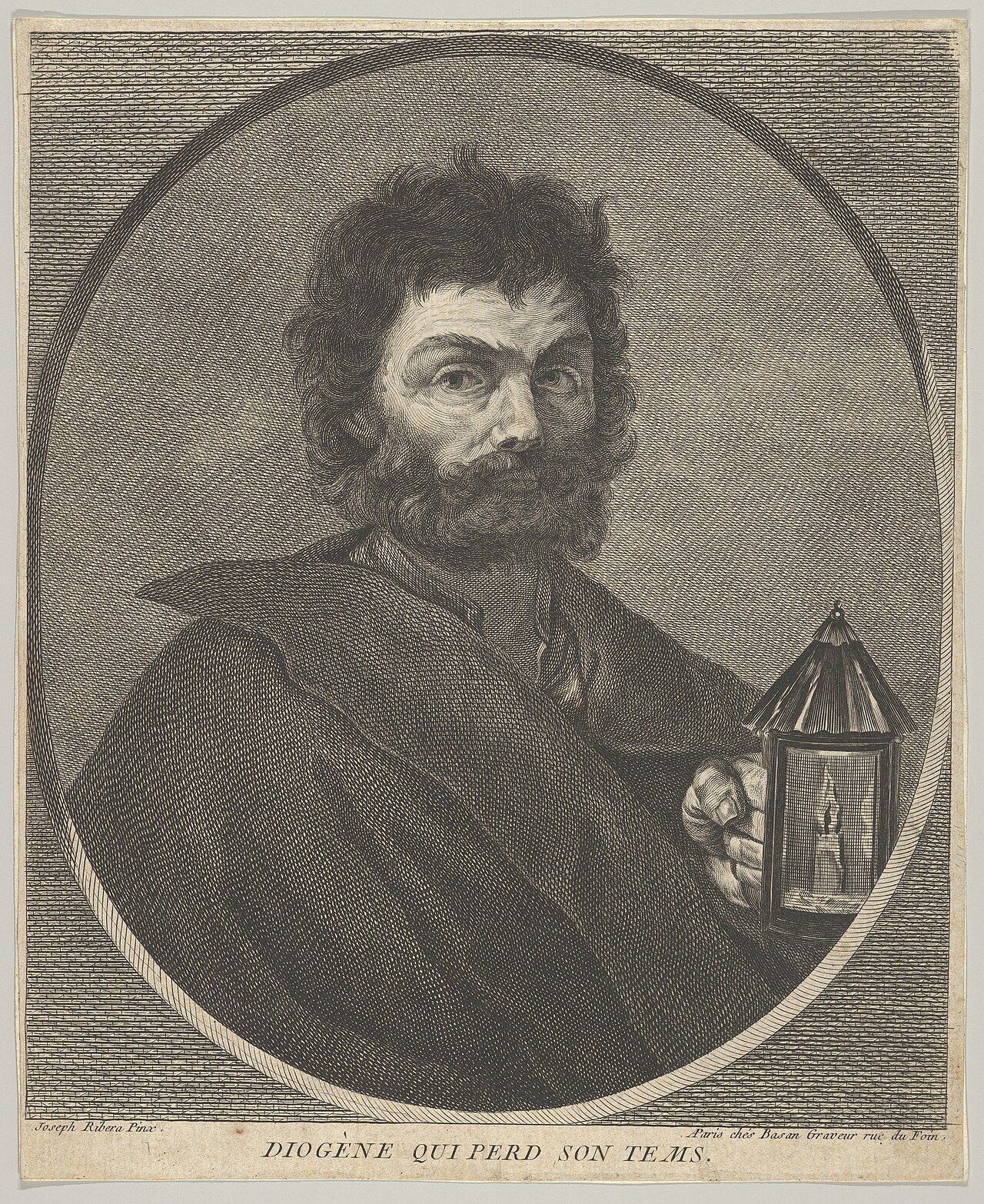
Διογένης ὁ Σινωπεύς
c. 410 – c. 323 BC
Pierre-François Basan after Jusepe de Ribera, Diogenes holding a lantern (print): an imagined likeness. Pierre-François Basan / After Jusepe de Ribera · CC0 · Wikimedia Commons
The Cynic philosopher who lived in deliberate poverty and shocked Athens and Corinth; Epictetus' model of a free man.
Biography · editorial
Diogenes was exiled from Sinope on the Black Sea, reportedly over a scandal involving the city’s coinage, and spent the rest of his life in Athens and Corinth. He lived with almost no possessions, in public, and set out to show by his own example how little a person needs.
Most of what survives about him is anecdote, much of it collected by Diogenes Laërtius. Behind the stories lie ideas the Stoics took up: that living according to nature means rejecting empty conventions, that virtue is the only good, and that the wise person belongs to the whole world rather than to a single city.
Epictetus admired him above almost everyone except Socrates, and in the Discourses he repeatedly appears as the example of a person whom nothing outside his own choices could make a slave.
Passages that mention Diogenes of Sinope
18 passages in 5 works, found by name in the English translations. This is a first-pass index: a few matches may be namesakes.
Discourses · 14
- Discourses 1.24 — …you gone, and prophesy for yourself; our only Fault is, that we have sent such a Spy. Diogenes was sent a Spy before you: but he told us other Tidings. He says, That Death is no Evil,…
- Discourses 2.3 — Diogenes rightly answered one, who desired Letters of Recommendation from him, "At first sight he…
- Discourses 2.13 — …how to speak, who talked in such a manner to Tyrants, and Judges, and in a Prison. Diogenes had studied how to speak, who talked in such a manner to Alexander, to Philip, to the…
- Discourses 2.16 — …thing of the same kind with Socrates, who died, and who lived, in such a Manner? Or with Diogenes? Do you observe either of these crying, or out of Humour, that he is not to see such a…
Show 10 more
- Discourses 2.19 — …For what doth it signify, whether one names the History of Hellanicus, or the Ethics of Diogenes, or Chrysippus, or Cleanthes? Have you then examined any of these Things, and formed a…
- Discourses 3.2 — …are], by these very Things; why do you aim to show it by others? Do not you know, that Diogenes showed some Sophist in this Manner, by extending his middle Finger; and, when he was mad…
- Discourses 3.21 — …undertake this Office, as he counselled Socrates to undertake the Office of Confutation; Diogenes, that of authoritative Reproof; Zeno, that of dogmatical Instruction. But you set up for…
- Discourses 3.22 — …Good and Evil where it is not; but do not observe it where it is: that He is a Spy, like Diogenes, when he was brought to Philip, after the Battle of Chæronea. For, in effect, a Cynic is…
- Discourses 3.24 — …also tell me, what Course of Life you desire to lead, who are a Zealot for Truth, and Diogenes, and Socrates? What would you do at Athens? These very same Things? Why then do you call…
- Discourses 3.26 — …who are genuine Philosophers; how Socrates lived, even with a wife and Children; how, Diogenes; how, Cleanthes, at once studying and drawing Water. If these are the Things you…
- Discourses 4.1 — …free, who do not endure Captivity; but, as soon as they are taken, die, and escape. Thus Diogenes somewhere says, That the only way to Freedom is to die with Ease. And he writes to the…
- Discourses 4.7 — …graciously; and relate to others, in what Manner he spoke to me? For is He Socrates, or Diogenes, that his Praise should show what I am? Or have I set my Heart on imitating his Manners?…
- Discourses 4.9 — …Zeno, you read Aristides and Euenus. Have you lost nothing then? Instead of Socrates and Diogenes, you admire him who can corrupt and entice the most Women. You set out your Person, and…
- Discourses 4.11 — …agreeable in his Conversation, but in his Person too. And, again, they write the same of Diogenes. For we ought not to fright the World from Philosophy, by the Appearance of our Person;…
Enchiridion · 1
- Enchiridion 15 — …only be worthy to feast with the gods, but to rule with them also. For, by thus doing, Diogenes and Heraclitus, and others like them, deservedly became divine, and were so recognized.
Fragments · 1
- Epictetus, Fragment 57 — Diogenes said that no labour was good, unless the end (purpose) of it was courage and strength…
Lives of Eminent Philosophers, Book VII · 1
- Lives 7.131 — …his Republic and Chrysippus in his treatise On Government [and not only they, but also Diogenes the Cynic and Plato]. Under such circumstances we shall feel paternal affection for all the…
On the Happy Life · 1
- On the Happy Life 18 — …neither Rutilius nor Cato? Will anyone care about being thought too rich by men for whom Diogenes the Cynic was not poor enough? That most energetic philosopher fought against all the desires of…