Precursors
Antisthenes
Ἀντισθένης
c. 445 – c. 365 BC
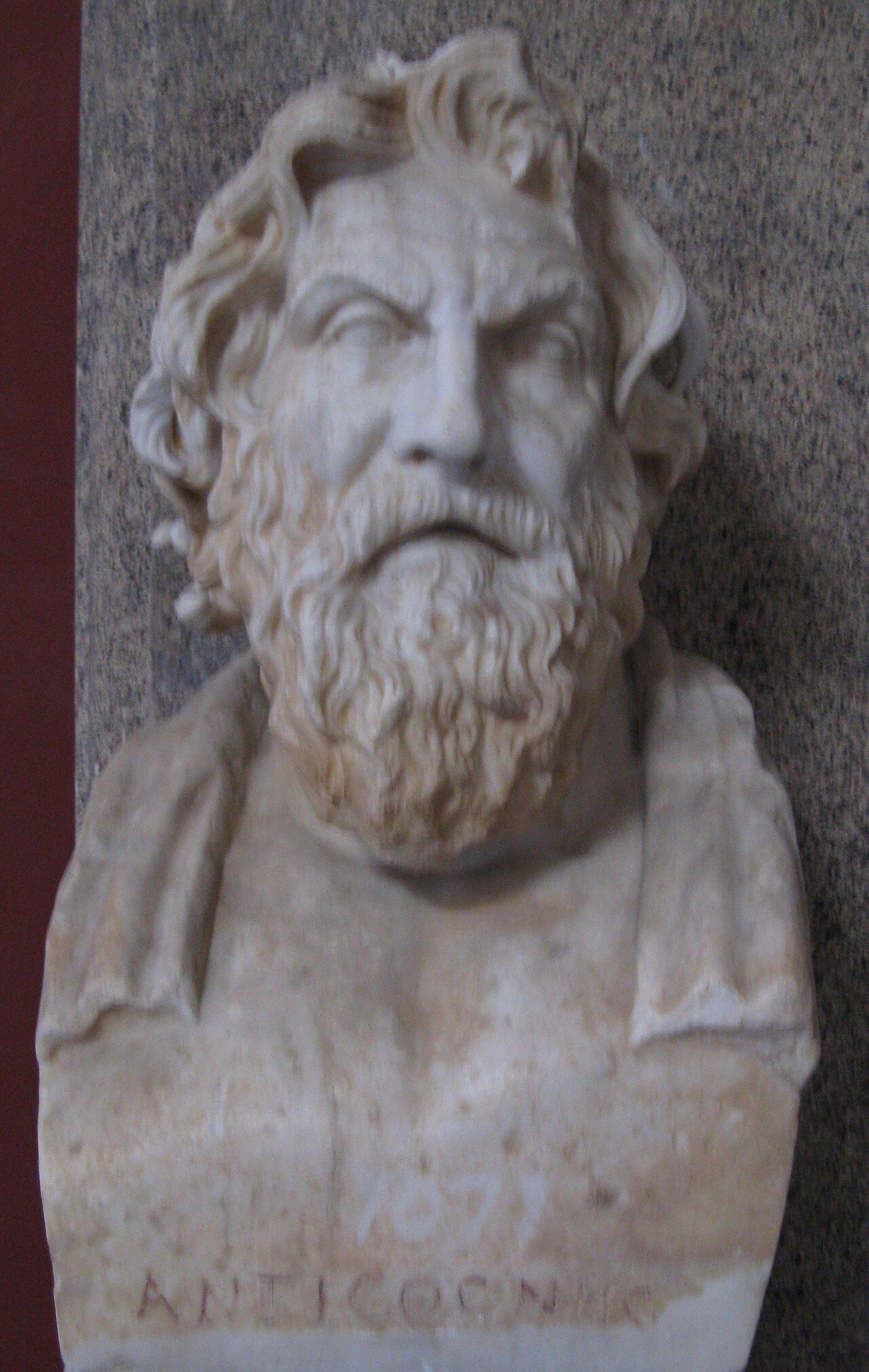
Bust of Antisthenes, Vatican Museums. Photo: Yair Haklai · CC BY-SA 4.0 · Wikimedia Commons
Companion of Socrates whom later writers named as the founder of Cynicism; he taught that virtue is enough for happiness.
Biography · editorial
Antisthenes was an Athenian who studied rhetoric before becoming one of Socrates’ closest companions. He wrote extensively, but his works survive only in fragments and reports.
He held that virtue can be taught, that it is sufficient for happiness, and that hard effort is a good rather than an evil. Ancient biographers, Diogenes Laërtius among them, made him the founder of the Cynic way of life and so a link between Socrates and the Stoics. Modern scholars doubt that he founded a school in any formal sense, but the line of descent the Stoics traced through him shaped how they saw themselves.
Passages that mention Antisthenes
12 passages in 5 works, found by name in the English translations. This is a first-pass index: a few matches may be namesakes.
Discourses · 6
- Discourses 1.17 — …Things. Who says this? Is it only Chrysippus, and Zeno, and Cleanthes? And doth not Antisthenes say it? And who is it, then, who has written, That the Beginning of a right Education is…
- Discourses 2.17 — …Sir; and you very finely imitate the Stile of Plato; and you, of Xenophon; and you, of Antisthenes." And thus, having relating your Dreams to each other, you return again to the same…
- Discourses 3.22 — …Minister, if he would be honoured with his Friendship; as Diogenes was the Friend of Antisthenes; as Crates, of Diogenes. Do you think, that he who only comes to him, and salutes him,…
- Discourses 3.24 — …have been exactly the same. Thus is Freedom acquired. Hence he used to say, "Ever since Antisthenes made me free, I have ceased to be a Slave," How did he make him free? Hear what he says.…
Show 2 more
- Discourses 4.1 — …your Freedom. For this is true Freedom. This is the Freedom, that Diogenes gained from Antisthenes; and declared, it was impossible, that he should ever after be a Slave, to any one.…
- Discourses 4.6 — …For you render yourself worthy of Pity by what you suffer upon being pitied. What says Antisthenes then? Have you never heard? "It is kingly, O Cyrus, to do well, and to be ill spoken…
Lives of Eminent Philosophers, Book VII · 3
- Lives 7.19 — …like that to ask such questions. Some one said that he did not in general agree with Antisthenes, whereupon Zeno produced that author’s essay on Sophocles, and asked him if he thought…
- Lives 7.91 — …treatise on Ethics, that virtue really exists is the fact that Socrates, Diogenes, and Antisthenes and their followers made moral progress. And for the existence of vice as a fundamental…
- Lives 7.168 — Cleanthes, son of Phanias, was a native of Assos. This man, says Antisthenes in his Successions of Philosophers, was at first a pugilist. He arrived in Athens, as…
Meditations · 1
- Meditations 7.36 — [From Antisthenes.] 'Tis royal to do well and be ill spoken of.
On the Firmness of the Wise Man · 1
- On the Firmness of the Wise Man 18 — …laughed no less than he did when he was drenched with dirty water by his wife Xanthippe. Antisthenes was reproached with his mother being a barbarian and a Thracian; he answered that the…
On Stoic Self-Contradictions · 1
- Plutarch, On Stoic Self-Contradictions 14 — …himself; but in these same, he sometimes with commendation brings forth this saying of Antisthenes, that either understanding or a halter is to be provided, as also that of Tyrtaeus, Come…