Roman Stoa
Cato the Younger
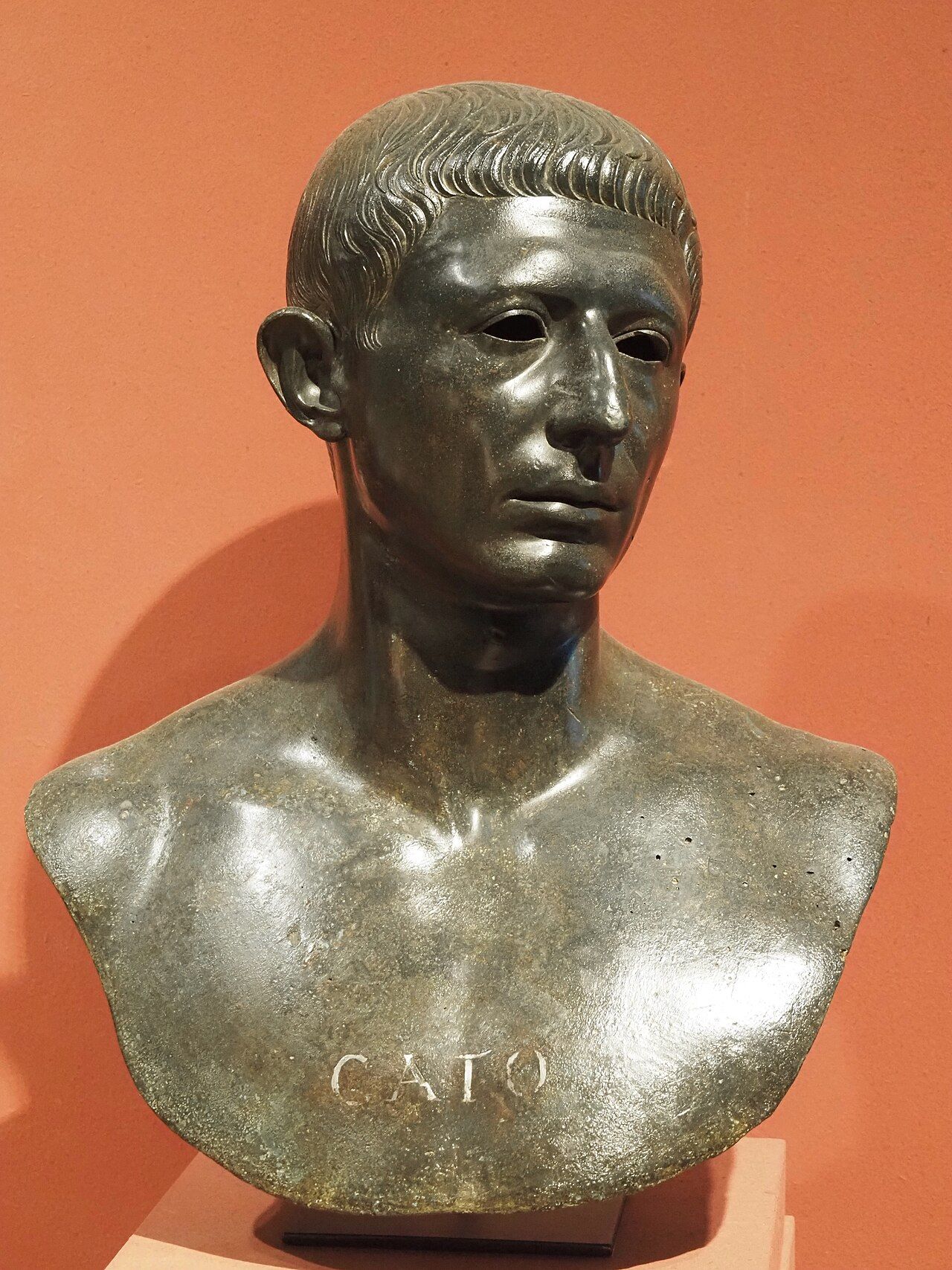
Marcus Porcius Cato
95 – 46 BC
Bronze bust of Cato the Younger from Volubilis (Morocco), 1st century AD, Archaeological Museum of Rabat. Photo: Laci3 · CC0 · Wikimedia Commons
Roman senator whose rigid integrity and suicide at Utica after Caesar's victory made him the Roman model of Stoic virtue.
Biography · editorial
Cato, great-grandson of Cato the Censor, was a leading conservative senator in the last decades of the Roman Republic. He was known for his austerity, incorruptibility and stubborn opposition to Julius Caesar.
After Caesar’s victory in the civil war, Cato took his own life at Utica in North Africa in 46 BC rather than accept Caesar’s pardon. Plutarch’s Life (in the Library) tells how he spent his last night reading Plato’s dialogue on the death of Socrates.
For later Stoics, Seneca above all, Cato was the nearest thing to a Roman sage, cited again and again as an example of firmness against fortune. Cicero makes him the spokesman for Stoic ethics in De Finibus Book III.
In the Library
Ancient accounts of Cato the Younger
Passages that mention Cato the Younger
71 passages in 10 works, found by name in the English translations. This is a first-pass index: a few matches may be namesakes.
Moral Letters to Lucilius · 48
- Letters 7.6 — …must be rescued from the mob; it is too easy to side with the majority. Even Socrates, Cato, and Laelius might have been shaken in their moral strength by a crowd that was unlike…
- Letters 11.10 — Choose therefore a Cato; or, if Cato seems too severe a model, choose some Laelius, a gentler spirit. Choose a…
- Letters 13.14 — …shed credit upon my life.” Socrates was ennobled by the hemlock draught. Wrench from Cato’s hand his sword, the vindicator of liberty, and you deprive him of the greatest share…
- Letters 14.12 — “Very well, then,” you retort, “do you regard the philosophy of Marcus Cato as moderate? Cato’s voice strove to check a civil war. Cato parted the swords of…
Show 44 more
- Letters 14.13 — …man ought to have taken any part in public affairs, and ask: “What do you mean, Marcus Cato? It is not now a question of freedom; long since has freedom gone to rack and ruin. The…
- Letters 24.6 — …pretty soon, when you reach the topic ‘On Despising Death,’ you will be telling me about Cato.” But why should I not tell you about Cato, how he read Plato’s book on that last…
- Letters 24.7 — …but only to live among the free. Now, since the affairs of mankind are beyond hope, let Cato be withdrawn to safety.”
- Letters 24.8 — …saying, he inflicted a mortal wound upon his body. After the physicians had bound it up, Cato had less blood and less strength, but no less courage; angered now not only at Caesar…
- Letters 24.10 — …“All is well with the commander!” Ought a general to die otherwise, especially one of Cato’s generals?
- Letters 25.6 — …set as a guard over yourself the authority of some man, whether your choice be the great Cato or Scipio, or Laelius,—or any man in whose presence even abandoned wretches would check…
- Letters 51.12 — Do you suppose that Cato would ever have dwelt in a pleasure-palace, that he might count the lewd women as they…
- Letters 58.12 — …Roman, Parthian; by colours,—white, black, yellow. The term comprises individuals also: Cato, Cicero, Lucretius. So “man” falls into the category genus, in so far as it includes…
- Letters 58.16 — …within the range of the eyes; but “man” in particular does; as, for example, Cicero, Cato. The term “animal” is not seen; it is grasped by thought alone. A particular animal,…
- Letters 64.10 — …then? Shall I admit into my soul with less than the highest marks of respect Marcus Cato, the Elder and the Younger, Laelius the Wise, Socrates and Plato, Zeno and Cleanthes? I…
- Letters 67.7 — …of conduct; it may include the chest in which Regulus was confined, or the wound of Cato which was torn open by Cato’s own hand, or the exile of Rutilius, or the cup of poison…
- Letters 67.13 — Behold Marcus Cato, laying upon that hallowed breast his unspotted hands, and tearing apart the wounds…
- Letters 70.19 — …the bonds of human servitude; you need not believe that this cannot be done except by a Cato,—Cato, who with his hand dragged forth the spirit which he had not succeeded in freeing…
- Letters 71.8 — You may say: “What then? Is there no difference between Cato’s being elected praetor and his failure at the polls? Or whether Cato is conquered or…
- Letters 71.10 — …of the name of Scipio may desert Scipio in Africa. But long ago destiny “saw to it that Cato should come to no harm.”
- Letters 71.11 — “He was conquered in spite of it all!” Well, you may include this among Cato’s “failures"; Cato will bear with an equally stout heart anything that thwarts him of…
- Letters 71.15 — Therefore the wise man will say just what a Marcus Cato would say, after reviewing his past life: “The whole race of man, both that which is and…
- Letters 71.16 — …it will be mingled with nature again, and will return to the universe. Therefore Cato’s honourable death was no less a good than his honourable life, since virtue admits of…
- Letters 71.17 — …be including it among the evils also; you will pronounce Socrates unhappy in his prison, Cato unhappy when he reopens his wounds with more courage than he showed in inflicting them,…
- Letters 79.14 — …be mad! Glory barely came to Socrates. And how long did our state remain in ignorance of Cato! They rejected him, and did not know his worth until they had lost him. If Rutilius had…
- Letters 82.12 — …whether wickedness or virtue has laid hold upon them. For instance, the death which in Cato’s case is glorious, is in the case of Brutus forthwith base and disgraceful. For this…
- Letters 82.13 — …as I was going on to remark, you see that death in itself is neither an evil nor a good; Cato experienced death most honourably, Brutus most basely. Everything, if you add virtue,…
- Letters 86.10 — …enter that dark bath, covered with a common sort of roof, knowing that therein your hero Cato, as aedile, or Fabius Maximus, or one of the Cornelii, has warmed the water with his own…
- Letters 87.9 — …helped the state as much as did Scipio’s,—for while Scipio fought against our enemies, Cato fought against our bad morals,—used to ride a donkey, and a donkey, at that, which…
- Letters 87.10 — …a general who had celebrated a triumph, a censor, and what is most noteworthy of all, a Cato, to be content with a single nag, and with less than a whole nag at that! For part of…
- Letters 94.27 — …into the fabric of song, or condensed into prose proverbs, like the famous Wisdom of Cato: “Buy not what you need, but what you must have. That which you do not need, is dear…
- Letters 95.69 — …at any rate, I myself should select no other simile for a hero. If I had to describe Cato, who was unterrified amid the din of civil war, who was first to attack the armies that…
- Letters 95.70 — …thus showing that the republic also had some backers. For it is not enough to say of Cato “without fear at its creakings.” Of course he is not afraid! He does not quail before…
- Letters 95.71 — …he is the only one whose standing is not in question, and that men do not ask whether Cato is free, but whether he is still among the free. Hence his contempt for danger and the…
- Letters 95.72 — …what men there have been of this kind. We might picture that last and bravest wound of Cato’s, through which Freedom breathed her last; or the wise Laelius and his harmonious life…
- Letters 97.1 — …will find—to man’s shame be it spoken—that sin never stalked abroad more openly than in Cato’s very presence.
- Letters 97.3 — …he had made the jury criminals like himself. All this was done at the trial in which Cato gave evidence, although that was his sole part therein. I shall quote Cicero’s actual…
- Letters 97.8 — All this bargaining took place in the presence of Pompey and Caesar, of Cicero and Cato,—yes, that very Cato whose presence, it is said, caused the people to refrain from…
- Letters 97.10 — All ages will produce men like Clodius, but not all ages men like Cato. We degenerate easily, because we lack neither guides nor associates in our wickedness,…
- Letters 98.12 — …by Regulus, poison by Socrates, exile by Rutilius, and a sword-inflicted death by Cato; therefore, let us also overcome something.”
- Letters 104.29 — Do you desire another case? Take that of the younger Marcus Cato, with whom Fortune dealt in a more hostile and more persistent fashion. But he withstood…
- Letters 104.30 — No one ever saw Cato change, no matter how often the state changed: he kept himself the same in all…
- Letters 104.31 — …men of the commonwealth; and there were left between them but these two—the Republic and Cato. I tell you, you will marvel when you see Atreus’ son, and Priam, and Achilles, wroth…
- Letters 104.33 — You see that man can endure toil: Cato, on foot, led an army through African deserts. You see that thirst can be endured: he…
- Letters 117.13 — …these have a certain essential quality which is sundered from body; for example: ‘I see Cato walking.’ The senses indicate this, and the mind believes it. What I see, is body, and…
- Letters 118.4 — …“Fortune, I have nothing to do with you. I am not at your service. I know that men like Cato are spurned by you, and men like Vatinius made by you. I ask no favours.” This is the…
- Letters 119.2 — I shall furnish you with a ready creditor, Cato’s famous one, who says: “Borrow from yourself!” No matter how small it is, it will be…
- Letters 120.19 — …consistency that abides; false things do not last. Some men are like Vatinius or like Cato by turns; at times they do not think even Curius stern enough, or Fabricius poor enough,…
- Letters 122.3 — There may be Antipodes dwelling in this same city of ours who, in Cato’s words, “have never seen the sun rise or set.” Do you think that these men know how to…
On Ends, Book III · 4
- De Finibus 3.4 — …habit of doing) the books which I wanted. And when I had arrived there, I found Marcus Cato, whom I did not know to be there, sitting in the library, surrounded by a number of the…
- De Finibus 3.10 — Then Cato said: But now, what books in the world are they that you are looking for here, when you…
- De Finibus 3.12 — All that you have been saying, Cato, I replied, you might say if you agreed with Pyrrho or Aristo; for you are not ignorant…
- De Finibus 3.40 — Certainly; Cato, said I, you are employing very admirable language, and such as expresses clearly what…
On the Firmness of the Wise Man · 4
- On the Firmness of the Wise Man 1 — …from afar assume a gently sloping outline. When just now mention was made of Marcus Cato, you whose mind revolts at injustice were indignant at Cato's own age having so little…
- On the Firmness of the Wise Man 2 — …they sold it they themselves were sold with it; I bade you have no fears on behalf of Cato himself, because the wise man can neither receive injury nor insult, and it is more…
- On the Firmness of the Wise Man 7 — …and transcends the common ordinary type is not often produced; but this very Marcus Cato himself, the mention of whom started this discussion, was a man who I fancy even…
- On the Firmness of the Wise Man 14 — …can overcome him. But what will the wise man do when he receives a cuff? He will do as Cato did when he was struck in the face; he did not flare up and revenge the outrage, he did…
On Peace of Mind · 3
- On Peace of Mind 7 — …of the brood of Socrates, or if you had been permitted to choose one from the age of Cato: an age which bore many men worthy to be born in Cato's time (just as it also bore many…
- On Peace of Mind 16 — …and Cicero to offer their necks to the swords of their own followers, when the great Cato, that living image of virtue, falls upon his sword and rips up both himself and the…
- On Peace of Mind 17 — …sometimes to be relaxed by amusement. Socrates did not blush to play with little boys, Cato used to refresh his mind with wine after he had wearied it with application to affairs…
Consolation to Helvia · 2
- Consolation to Helvia 9 — …what a man that must have been who attracted the admiration of one whom even his friend Cato admired! Brutus goes on to say:—'Gaius Caesar sailed past Mytilene without landing,…
- Consolation to Helvia 13 — …regarded as a prison. Was any one ever so blind to the truth as to suppose that Marcus Cato was disgraced by his double defeat in his candidature for the praetorship and the…
Consolation to Marcia · 2
- Consolation to Marcia 20 — …war, pillage, hosts of Catilines. Would it not have been a good thing for Marcus Cato if the sea had swallowed him up when he was returning from Cyprus after sequestrating…
- Consolation to Marcia 22 — …the piercing of one's breast by a self-inflicted wound; he was not of holier life than Cato. When you look at these examples, you will perceive that nature deals very kindly with…
On Anger · 2
- On Anger 2.32 — …pain for pain has more excuse for his sin; that is all. Someone who did not know Marcus Cato struck him in the public bath in his ignorance, for who would knowingly have done him an…
- On Anger 3.38 — …said he, "but I am not sure that I ought not to be angry." Yet how much better did our Cato behave? When he was pleading, one Lentulus, whom our fathers remember as a demagogue and…
On Benefits · 2
- On Benefits 5.7 — …by him; why should not Socrates be grateful to himself for having taught himself? Marcus Cato said, "Borrow from yourself whatever you lack;" why, then, if I can lend myself…
- On Benefits 5.17 — …done if victorious; Rutilius found his virtue rewarded with a hiding-place in Asia; to Cato the Roman people refused the praetorship, and persisted in refusing the consulship. We…
On Providence · 2
- On Providence 2 — …spectacle Jupiter could find on earth, should he turn his eyes thither, than that of Cato, after his party had more than once been defeated, still standing upright amid the ruins…
- On Providence 3 — …fire, Fabricius by poverty, Rutilius by exile, Regulus by torture, Socrates by poison, Cato by death: it is ill fortune alone that discovers these glorious examples. Was Mucius…
On the Happy Life · 2
- On the Happy Life 18 — …that evil speaking will respect anything, seeing that it respected neither Rutilius nor Cato? Will anyone care about being thought too rich by men for whom Diogenes the Cynic was…
- On the Happy Life 21 — …from whence they can always be recovered without any squabble with their trustee? Marcus Cato, when he was praising Curius and Coruncanius and that century in which the possession of…