Sources & reception
Cicero
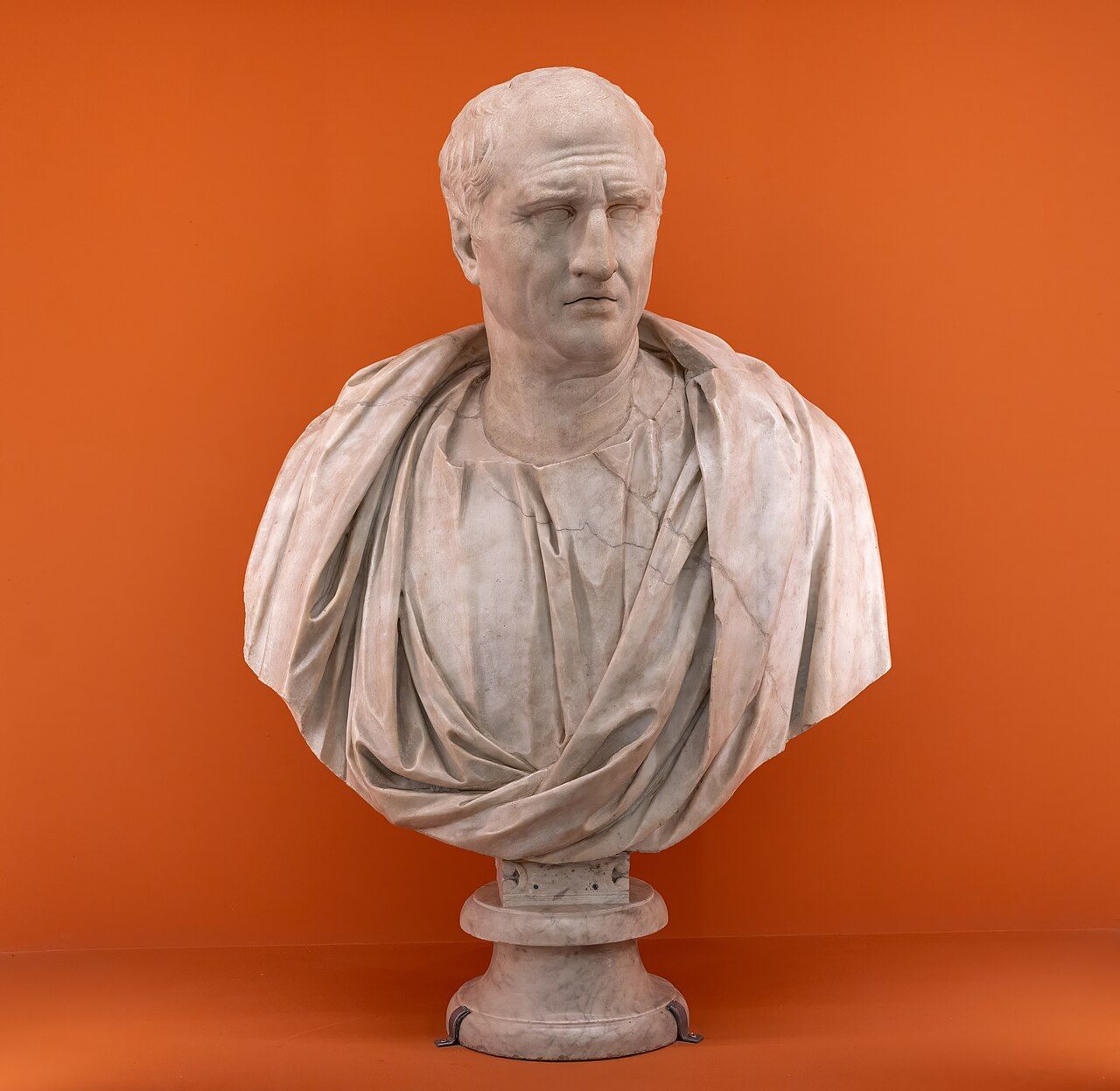
Marcus Tullius Cicero
106 – 43 BC
Bust of Cicero, Capitoline Museums, Rome. Photo: Wilfredor · CC0 · Wikimedia Commons
Roman statesman and orator whose philosophical dialogues are a major source for Stoic ideas, which he set out sympathetically while keeping his own Academic independence.
Biography · editorial
Cicero was the leading orator of the late Roman Republic and consul in 63 BC. He studied philosophy throughout his life, including in Athens and in Rhodes, where he heard Posidonius, and he lived for years with the Stoic Diodotus in his household.
In the last years of his life, excluded from politics under Caesar, he wrote a series of dialogues to make Greek philosophy available in Latin. He described himself as an Academic, free to weigh the schools against each other, but he treated Stoic ethics with great respect. De Finibus Book III, in the Library, gives Cato a full exposition of Stoic ethics. De Officiis, also in the Library and written for his son in 44 BC, adapts Panaetius’ work on appropriate action.
He was killed in 43 BC on the orders of Mark Antony.
In the Library
Works
Passages that mention Cicero
49 passages in 10 works, found by name in the English translations. This is a first-pass index: a few matches may be namesakes.
Moral Letters to Lucilius · 19
- Letters 17.2 — …how great is the help we receive from philosophy in everything, everywhere,—how, (to use Cicero’s language,) it not only succours us in the greatest matters but also descends to the…
- Letters 21.4 — …who was petitioned for the title which Idomeneus sought, are sunk in deep oblivion. Cicero’s letters keep the name of Atticus from perishing. It would have profited Atticus…
- Letters 40.11 — …even when writing, have become accustomed to separate our words. And our compatriot Cicero, with whom Roman oratory sprang into prominence, was also a slow pacer. The Roman…
- Letters 49.5 — …which, no matter how carefully it is guarded, cannot suffice even for necessary things. Cicero declared that if the number of his days were doubled, he should not have time to read…
Show 15 more
- Letters 58.6 — …If I cannot do this, I shall risk it even though it put you out of humour. I have Cicero, as authority for the use of this word, and I regard him as a powerful authority. If you…
- Letters 58.12 — …Parthian; by colours,—white, black, yellow. The term comprises individuals also: Cato, Cicero, Lucretius. So “man” falls into the category genus, in so far as it includes many kinds;…
- Letters 58.16 — …not come within the range of the eyes; but “man” in particular does; as, for example, Cicero, Cato. The term “animal” is not seen; it is grasped by thought alone. A particular…
- Letters 97.3 — …in which Cato gave evidence, although that was his sole part therein. I shall quote Cicero’s actual words, because the facts are so bad as to pass belief:
- Letters 97.8 — All this bargaining took place in the presence of Pompey and Caesar, of Cicero and Cato,—yes, that very Cato whose presence, it is said, caused the people to refrain…
- Letters 100.7 — Read Cicero: his style has unity; it moves with a modulated pace, and is gentle without being…
- Letters 100.9 — Mention someone whom you may rank ahead of Fabianus. Cicero, let us say, whose books on philosophy are almost as numerous as those of Fabianus. I…
- Letters 107.10 — …which I shall allow myself to render in Latin, after the example of the eloquent Cicero. If you like them, make the most of them; if they displease you, you will understand…
- Letters 108.30 — When Cicero’s book On the State is opened by a philologist, a scholar, or a follower of philosophy,…
- Letters 108.32 — …his notebook the forms of words, noting that reapse, equivalent to re ipsa, is used by Cicero, and sepse just as frequently, which means se ipse. Then he turns his attention to…
- Letters 108.34 — …and Vergil from Ennius. For there is a couplet by Ennius, preserved in this same book of Cicero’s, On the State: If it be right for a mortal to scale the regions of Heaven, Then the…
- Letters 111.1 — …to general use by us; the name, too, has met with opposition. But the word which Cicero used seems to me most suitable: he calls them cavillationes.
- Letters 114.16 — …just manage to come in at the end of a period? Or again of that softly-concluding style, Cicero-fashion, with a gradual and gently poised descent always the same and always with the…
- Letters 118.1 — …that it is safe to trust you, so I shall pay in advance, and yet not do as the eloquent Cicero bids Atticus do: “Even if you have nothing to say, write whatever enters your head.”
- Letters 118.2 — …be something for me to write about, even omitting all the kinds of news with which Cicero fills his correspondence: what candidate is in difficulties, who is striving on borrowed…
Life of Cato the Younger · 13
- Plutarch, Cato Minor 6 — …a certain Memmius remarked in company that Cato spent his entire nights in drinking, Cicero answered him by saying: Thou shouldst add that he spends his entire days in throwing…
- Plutarch, Cato Minor 19 — …was calumniating to the people priests and priestesses, among whom Fabia, a sister of Cicero’s wife Terentia, was in danger of conviction. But Cato put Clodius to such shame that he…
- Plutarch, Cato Minor 21 — …and if Cato said no, the man would take his word and go away. When the trial was held, Cicero, who was consul at that time and one of Murena’s advocates, took advantage of Cato’s…
- Plutarch, Cato Minor 22 — Before he entered upon his tribuneship, and during the consulship of Cicero, he maintained the authority of that magistrate in many conflicts, and above all in the…
Show 9 more
- Plutarch, Cato Minor 23 — …speech of Cato which has been preserved, we are told, and its preservation was due to Cicero the consul, who had previously given to those clerks who excelled in rapid writing…
- Plutarch, Cato Minor 31 — …and the other would be at hand with support for the laws. But the party of Lucullus and Cicero, ranging themselves with Bibulus, the other consul, opposed the measures, and above all…
- Plutarch, Cato Minor 32 — …But the one who was most successful in persuading and inducing him to take the oath was Cicero the orator, who advised and showed him that it was possibly even a wrong thing to think…
- Plutarch, Cato Minor 33 — …plebeian rank and got him elected tribune of the people, a man who, in order to secure Cicero’s banishment as his reward, was using all his political influence for the gratification…
- Plutarch, Cato Minor 34 — …this was annoying and vexatious to them. Clodius, too, could not even hope to overthrow Cicero while Cato was at Rome, but since he was scheming for this above all else, when he had…
- Plutarch, Cato Minor 35 — Subjected to such constraint as this, Cato advised Cicero, whose enemies were trying to banish him, not to raise a faction or plunge the city into…
- Plutarch, Cato Minor 40 — But Cicero had now come back from the exile into which he was driven by Clodius, and, relying on…
- Plutarch, Cato Minor 50 — …into the forum without shoes or tunic and walked about there with his intimates. But Cicero finds fault with him because, when affairs demanded a man like him for office, he would…
- Plutarch, Cato Minor 55 — …crossed over to Corcyra, where the fleet was, he offered to give up the command to Cicero, who was of consular rank, while he himself had been only a praetor. But Cicero would…
On Duties · 6
- De Officiis 1.3 — And therefore, my dear Cicero, I cordially recommend you to read carefully not only my orations but also these books…
- De Officiis 2.8 — …subject has been, I think, quite fully set forth in my Academics. And although, my dear Cicero, you are a student of that most ancient and celebrated school of philosophy, with…
- De Officiis 2.44 — …distinguished name acquired either by inheritance from his father (as, I think, my dear Cicero, is your good fortune) or by some chance or happy combination of circumstances, the eyes…
- De Officiis 3.5 — But, my dear Cicero, while the whole field of philosophy is fertile and productive and no portion of it…
Show 2 more
- De Officiis 3.33 — …axioms be assumed as true, in order more easily to explain their meaning, so, my dear Cicero, I ask you to assume with me, if you can, that nothing is worth the seeking for its own…
- De Officiis 3.121 — …long as you are abroad, I shall converse with you thus at a distance. Farewell, my dear Cicero, and be assured that, while you are the object of my deepest affection, you will be…
On Benefits · 3
- On Benefits 4.30 — …being good, if the respect felt for good men does not cease with their lives. What made Cicero's son a consul, except his father? What lately brought Cinna out of the camp of the…
- On Benefits 5.17 — …It sent Camillus and Scipio into exile; even after the death of Catiline it exiled Cicero, destroyed his house, plundered his property, and did everything which Catiline would…
- On Benefits 7.6 — …the one owns the thing, the other owns the use of the thing. We speak of the books of Cicero. Dorus, the bookseller, calls these same books his own; the one claims them because he…
On Anger · 2
- On Anger 2.2 — …about things that happened long ago. We often feel angry with Clodius for banishing Cicero, and with Antonius for murdering him. Who is not indignant with the wars of Marius, the…
- On Anger 3.37 — …Hortensius, if you had found fault with his speeches, would have quarreled with you, and Cicero, if you had laughed at his poetry, would have been your enemy. A candidate for office,…
On Peace of Mind · 2
- On Peace of Mind 11 — …value, and count the breath of life as a cheap matter. "We dislike gladiators," says Cicero, "if they are eager to save their lives by any means whatever: but we look favourably…
- On Peace of Mind 16 — …ends; when Socrates is forced to die in prison, Rutilius to live in exile, Pompeius and Cicero to offer their necks to the swords of their own followers, when the great Cato, that…
Consolation to Marcia · 1
- Consolation to Marcia 20 — …infamous than that a Pompeius should owe his life to the clemency of a king? If Marcus Cicero had fallen at the time when he avoided those daggers which Catiline aimed equally at him…
On Clemency · 1
- On Clemency 1.10 — …opponents. Soon afterwards his clemency gave him a Domitius, a Messala, an Asinius, a Cicero, and all the flower of the state. For what a long time he waited for Lepidus to die: for…
On the Firmness of the Wise Man · 1
- On the Firmness of the Wise Man 17 — …He made many jokes about his feet and his short neck, and thus escaped the sarcasms of Cicero above all, and of his other enemies, of whom he had more than he had diseases. If he,…
On Providence · 1
- On Providence 3 — …than Regulus, that man, whether he says so or not, would rather have been Terentia (than Cicero). Do you consider Socrates to have been badly used, because he took that draught which…