Middle Stoa
Panaetius
Παναίτιος
c. 185 – c. 109 BC
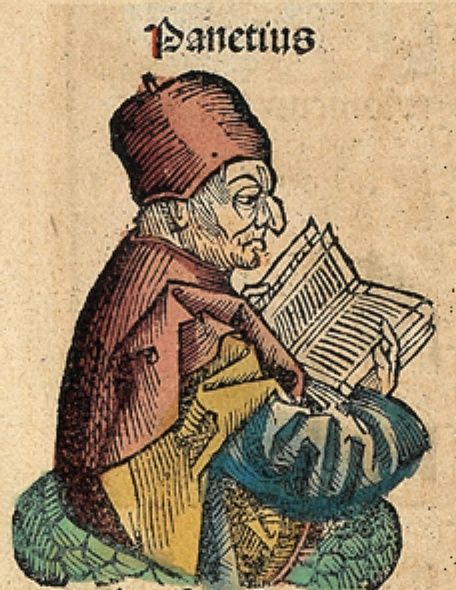
Imaginary woodcut portrait of Panaetius from the Nuremberg Chronicle (1493). Hartmann Schedel; derivative work by Singinglemon · Public domain · Wikimedia Commons
Rhodian Stoic who brought the school to the Roman elite; his work on appropriate action is the basis of Cicero's De Officiis.
Biography · editorial
Panaetius of Rhodes studied with Diogenes of Babylon and Antipater, then spent many years in Rome as a friend of Scipio Aemilianus and his circle. He became head of the Stoa in Athens after Antipater.
He gave Stoic ethics a more practical and less forbidding shape, paying attention to people making progress rather than only to the ideal sage. His treatise on appropriate action (kathēkon) is the model for the first two books of Cicero’s De Officiis, which says so explicitly. He was also unusual among Stoics in doubting the doctrine of a periodic conflagration of the world.
Passages that mention Panaetius
32 passages in 3 works, found by name in the English translations. This is a first-pass index: a few matches may be namesakes.
On Duties · 23
- De Officiis 1.7 — …subject of duty, I should like at the outset to define what duty is, as, to my surprise, Panaetius has failed to do. For every systematic development of any subject ought to begin with a…
- De Officiis 1.9 — The consideration necessary to determine conduct is, therefore, as Panaetius thinks, a threefold one: first, people question whether the contemplated act is morally…
- De Officiis 1.10 — …of two expedients is offered, which one is more expedient. Thus the question which Panaetius thought threefold ought, we find, to be divided into five parts. First, therefore, we…
- De Officiis 1.90 — …in this word of warning: The higher we are placed, the more humbly should we walk. Panaetius tells us that Africanus, his pupil and friend, used to say: As, when horses have become…
Show 19 more
- De Officiis 1.152 — …arise, as to which of two moral actions is morally better—a point overlooked by Panaetius. For, since all moral rectitude springs from four sources (one of which is prudence; the…
- De Officiis 1.161 — …which one is morally better. This point, as I remarked above, has been overlooked by Panaetius. But let us now pass on to what remains.
- De Officiis 2.16 — …longer on this point than was necessary. For who is there to whom those facts which Panaetius narrates at great length are not self-evident—namely, that no one, either as a general…
- De Officiis 2.35 — …we must employ familiar words in their common acceptation; and this was the practice of Panaetius likewise. But let us return to the subject.
- De Officiis 2.51 — …to say this, especially in an ethical treatise, if it were not also the position of Panaetius, that strictest of Stoics. Then, too, briefs for the defence are most likely to bring…
- De Officiis 2.60 — …and new temples; and yet the greatest philosophers do not approve of them—our Panaetius himself, for example, whom I am following, not slavishly translating, in these books;…
- De Officiis 2.76 — Panaetius praises Africanus for his integrity in public life. Why should he not? But Africanus had…
- De Officiis 2.86 — …Stoic philosopher who recently died at Athens, claims that two points were overlooked by Panaetius—the care of health and of property. I presume that the eminent philosopher overlooked…
- De Officiis 2.88 — …one expediency against another;—for this, as I stated, is a fourth point overlooked by Panaetius. For not only are physical advantages regularly compared with outward advantages [and…
- De Officiis 3.7 — Panaetius, then, has given us what is unquestionably the most thorough discussion of moral duties…
- De Officiis 3.8 — And I wonder the more at this, because Posidonius, a pupil of his, records that Panaetius was still alive thirty years after he published those three books. And I am surprised…
- De Officiis 3.9 — …the view of those who say that that point was not overlooked but purposely omitted by Panaetius, and that it was not one that ever needed discussion, because there never can be such a…
- De Officiis 3.10 — …He writes in one of his letters that Publius Rutilius Rufus, who also was a pupil of Panaetius's, used to say that as no painter had been found to complete that part of the Venus of…
- De Officiis 3.11 — In regard to Panaetius's real intentions, therefore, no doubt can be entertained. But whether he was or was not…
- De Officiis 3.12 — But if Panaetius were the sort of man to say that virtue is worth cultivating only because it is…
- De Officiis 3.18 — …against what they think the expedient; good men are not. And so I believe that when Panaetius stated that people were accustomed to hesitate to do such weighing, he meant precisely…
- De Officiis 3.33 — It is subjects of this sort that I believe Panaetius would have followed up, had not some accident or business interfered with his design.…
- De Officiis 3.34 — In the first place, I must undertake the defence of Panaetius on this point; for he has said, not that the truly expedient could under certain…
- De Officiis 3.63 — Now I observe that Hecaton of Rhodes, a pupil of Panaetius, says in his books on Moral Duty dedicated to Quintus Tubero that it is a wise man's…
Lives of Eminent Philosophers, Book VII · 6
- Lives 7.41 — …of Ptolemaïs, it is true, begins with Ethics; but Apollodorus puts Ethics second, while Panaetius and Posidonius begin with Physics, as stated by Phanias, the pupil of Posidonius, in the…
- Lives 7.92 — Panaetius, however, divides virtue into two kinds, theoretical and practical; others make a…
- Lives 7.128 — …will be sufficient in itself for well-being —despising all things that seem troublesome. Panaetius, however, and Posidonius deny that virtue is self-sufficing: on the contrary, health is…
- Lives 7.142 — …his work On the Cosmos, by Cleanthes, and by Antipater in his tenth book On the Cosmos. Panaetius, however, maintained that the world is indestructible. The doctrine that the world is a…
Show 2 more
- Lives 7.149 — …the second book of his Physical Discourse and the fifth book of his De divinatione. But Panaetius denies that divination has any real existence.
- Lives 7.163 — …of Alexinus. Against the Dialecticians, three books. Letters to Cleanthes, four books. Panaetius and Sosicrates consider the Letters to be alone genuine; all the other works named they…
Moral Letters to Lucilius · 3
- Letters 33.4 — …from the general stock; to whom shall we credit them? To Zeno, Cleanthes, Chrysippus, Panaetius, or Posidonius? We Stoics are not subjects of a despot: each of us lays claim to his own…
- Letters 116.5 — I think that Panaetius gave a very neat answer to a certain youth who asked him whether the wise man should…
- Letters 116.6 — Now that which Panaetius replied to the question about love may be applied, I believe, to all the emotions. In so…