Middle Stoa
Posidonius
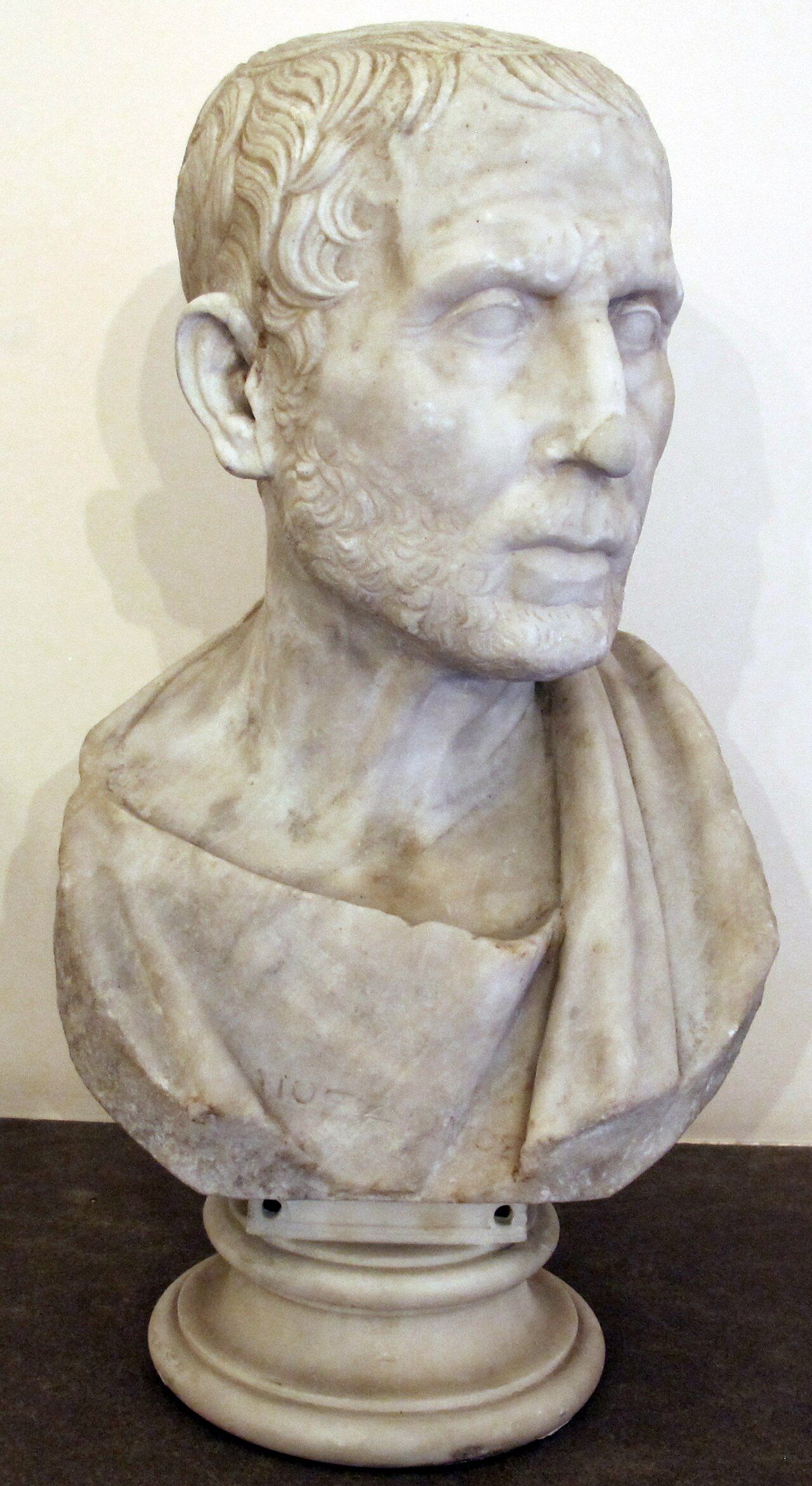
Ποσειδώνιος
c. 135 – c. 51 BC
Bust of Posidonius, National Archaeological Museum of Naples. Photo: Sailko · CC BY 3.0 · Wikimedia Commons
Polymath Stoic of Rhodes: philosopher, historian and scientist, whose lectures Cicero attended.
Biography · editorial
Posidonius came from Apamea in Syria, studied with Panaetius in Athens and settled in Rhodes, where he ran a school and served the city as a magistrate and ambassador to Rome. Cicero studied with him, and Pompey visited him.
His interests were vast: history, geography, astronomy, the tides, and the measurement of the earth, as well as ethics and theology. He emphasised the interconnection of all parts of the cosmos and gave the irrational parts of the soul a larger role in explaining the passions than Chrysippus had. Only fragments survive, but Seneca cites him often in the Letters, and Diogenes Laërtius draws on him throughout Lives Book VII.
Passages that mention Posidonius
59 passages in 3 works, found by name in the English translations. This is a first-pass index: a few matches may be namesakes.
Lives of Eminent Philosophers, Book VII · 30
- Lives 7.38 — …according to Hippobotus were pupils of Zeno: Philonides of Thebes; Callippus of Corinth; Posidonius of Alexandria; Athenodorus of Soli; and Zeno of Sidon. I have decided to give a general…
- Lives 7.39 — …as also Eudromus in his Elementary Treatise on Ethics, Diogenes the Babylonian, and Posidonius. These parts are called by Apollodorus Heads of Commonplace; by Chrysippus and Eudromus…
- Lives 7.41 — …it is true, begins with Ethics; but Apollodorus puts Ethics second, while Panaetius and Posidonius begin with Physics, as stated by Phanias, the pupil of Posidonius, in the first book of…
- Lives 7.54 — …Again, certain others of the older Stoics make Right Reason the standard; so also does Posidonius in his treatise On the Standard.
Show 26 more
- Lives 7.60 — Posidonius in his treatise On Style defines a poetical phrase as one that is metrical or…
- Lives 7.62 — …case that A house has three times fallen, in the other that a dancing-girl has fallen. Posidonius defines Dialectic as the science dealing with truth, falsehood, and that which is…
- Lives 7.84 — …adopted by Chrysippus, Archedemus, Zeno of Tarsus, Apollodorus, Diogenes, Antipater, and Posidonius, and their disciples. Zeno of Citium and Cleanthes treated the subject somewhat less…
- Lives 7.87 — …towards which nature guides us. So too Cleanthes in his treatise On Pleasure, as also Posidonius, and Hecato in his work On Ends. Again, living virtuously is equivalent to living in…
- Lives 7.91 — …supervene and they occur even in bad men: for instance, health, courage. The proof, says Posidonius in the first book of his treatise on Ethics, that virtue really exists is the fact that…
- Lives 7.92 — …a threefold division of it into logical, physical, and ethical; while by the school of Posidonius four types are recognized, and more than four by Cleanthes, Chrysippus, Antipater, and…
- Lives 7.103 — …and bad use can be made; therefore wealth and health are not goods. On the other hand, Posidonius maintains that these things too are among goods. Hecato in the ninth book of his…
- Lives 7.124 — And the wise man, they say, will offer prayers, and ask for good things from the gods: so Posidonius in the first book of his treatise On Duties, and Hecato in his third book On Paradoxes.…
- Lives 7.128 — …for well-being —despising all things that seem troublesome. Panaetius, however, and Posidonius deny that virtue is self-sufficing: on the contrary, health is necessary, and some means…
- Lives 7.129 — …study of philosophy, since at that rate we should have to give up life altogether: so Posidonius in his Exhortations. Chrysippus allows that the ordinary Greek education is…
- Lives 7.134 — …first book of his Physics towards the end, Archedemus in his treatise On Elements, and Posidonius in the second book of his Physical Exposition. There is a difference, according to them,…
- Lives 7.135 — …depth. That surface exists not only in our thought but also in reality is maintained by Posidonius in the third book of his Celestial Phenomena. A line is the extremity of a surface or…
- Lives 7.138 — …defined as the individual being qualifying the whole of substance, or, in the words of Posidonius in his elementary treatise on Celestial Phenomena, a system made up of heaven and earth…
- Lives 7.139 — …his treatise On the Cosmos. Chrysippus in the first book of his work On Providence and Posidonius in his book On the Gods say that the heaven, but Cleanthes that the sun, is the ruling…
- Lives 7.140 — …finite, having a spherical shape, such a shape being the most suitable for motion, as Posidonius says in the fifth book of his Physical Discourse and the disciples of Antipater in their…
- Lives 7.142 — …by Zeno in his treatise On the Whole, by Chrysippus in the first book of his Physics, by Posidonius in the first book of his work On the Cosmos, by Cleanthes, and by Antipater in his tenth…
- Lives 7.143 — …Zeno in his treatise On the Whole, by Chrysippus, by Apollodorus in his Physics, and by Posidonius in the first book of his Physical Discourse. By the totality of things, the All, is…
- Lives 7.144 — …the zodiac. Similarly the moon travels in a spiral path. The sun is pure fire: so Posidonius in the seventh book of his Celestial Phenomena. And it is larger than the earth, as the…
- Lives 7.145 — …the moon from fresh waters, with an admixture of air, close to the earth as it is: thus Posidonius in the sixth book of his Physics; the other heavenly bodies being nourished from the…
- Lives 7.146 — …the zodiac, when she is in the constellations of Cancer, Scorpio, Aries and Taurus: so Posidonius and his followers tell us.
- Lives 7.148 — …world and the heaven, as well as by Chrysippus in his first book Of the Gods, and by Posidonius in his first book with the same title. Again, Antipater in the seventh book of his work…
- Lives 7.149 — …things happen by fate or destiny is maintained by Chrysippus in his treatise De fato, by Posidonius in his De fato, book ii., by Zeno and by Boëthus in his De fato, book i. Fate is defined…
- Lives 7.152 — …The rainbow is explained as the reflection of the sun’s rays from watery clouds or, as Posidonius says in his Meteorology, an image of a segment of the sun or moon in a cloud suffused…
- Lives 7.153 — …crumbled by a wind; while snow is moist matter from a cloud which has congealed: so Posidonius in the eighth book of his Physical Discourse. Lightning is a kindling of clouds from…
- Lives 7.154 — …when the wind finds its way into, or is imprisoned in, the hollow parts of the earth: so Posidonius in his eighth book; and some of them are tremblings, others openings of the earth,…
- Lives 7.157 — Zeno of Citium and Antipater, in their treatises De anima, and Posidonius define the soul as a warm breath; for by this we become animate and this enables us to…
Moral Letters to Lucilius · 26
- Letters 33.4 — …stock; to whom shall we credit them? To Zeno, Cleanthes, Chrysippus, Panaetius, or Posidonius? We Stoics are not subjects of a despot: each of us lays claim to his own freedom. With…
- Letters 78.28 — …short this time may be, we shall make it long by knowing how to employ it. For, as Posidonius says: “A single day among the learned lasts longer than the longest life of the…
- Letters 83.10 — Posidonius pleads the cause of our master Zeno in the only possible way; but it cannot, I hold, be…
- Letters 83.12 — But let us admit, indeed, that he meant what Posidonius says; even so, the conclusion is false,—that secrets are not entrusted to an habitual…
Show 22 more
- Letters 87.31 — I think that the reasoning of Posidonius is better: he holds that riches are a cause of evil, not because, of themselves, they do…
- Letters 87.35 — Posidonius thinks that the syllogism should be framed as follows: “Things which bestow upon the…
- Letters 87.38 — …recognized by our school, but the Peripatetics both concoct it and give its solution. Posidonius, however, remarks that this fallacy, which has been bandied about among all the schools…
- Letters 88.21 — Posidonius divides the arts into four classes: first we have those which are common and low, then…
- Letters 90.5 — Accordingly, in that age which is maintained to be the golden age, Posidonius holds that the government was under the jurisdiction of the wise. They kept their hands…
- Letters 90.7 — Up to this point I agree with Posidonius; but that philosophy discovered the arts of which life makes use in its daily round I…
- Letters 90.11 — On another point also I differ from Posidonius, when he holds that mechanical tools were the invention of wise men. For on that basis…
- Letters 90.13 — Nor do I consider this question so subtle as Posidonius thinks, namely, whether the hammer or the tongs came first into use. They were both…
- Letters 90.20 — …the charm of eloquence wins even great men away from the truth. Take, for example, Posidonius—who, in my estimation, is of the number of those who have contributed most to…
- Letters 90.21 — Posidonius then passes on to the farmer. With no less eloquence he describes the ground which is…
- Letters 90.23 — …discovered and the other devices whose heat will render obedience to the sage’s will.” Posidonius came very near declaring that even the cobbler’s trade was the discovery of the wise man.
- Letters 90.25 — “But,” says Posidonius, “the wise man did indeed discover all these things; they were, however, too petty for…
- Letters 90.30 — It is my opinion that the wise man has not withdrawn himself, as Posidonius thinks, from those arts which we were discussing, but that he never took them up at all.…
- Letters 90.31 — “But Anacharsis,” says Posidonius, “invented the potter’s wheel, whose whirling gives shape to vessels.” Then because the…
- Letters 90.32 — But Posidonius again remarks: “Democritus is said to have discovered the arch, whose effect was that…
- Letters 92.10 — …joined to this the useless and fleeting flesh, fitted only for the reception of food, as Posidonius remarks. This divine virtue ends in foulness, and to the higher parts, which are…
- Letters 94.38 — On this point I disagree with Posidonius, who says: “I do not think that Plato’s Laws should have the preambles added to them.…
- Letters 95.65 — Posidonius holds that not only precept-giving (there is nothing to prevent my using this word), but…
- Letters 104.22 — Live with Chrysippus, with Posidonius: they will make you acquainted with things earthly and things heavenly; they will bid…
- Letters 108.38 — They have been spoken by Plato, spoken by Zeno, spoken by Chrysippus or by Posidonius, and by a whole host of Stoics as numerous as excellent. I shall show you how men can…
- Letters 113.28 — At this point I would quote you a saying of our philosopher Posidonius: “There are never any occasions when you need think yourself safe because you wield the…
- Letters 121.1 — …me first of all match you with other opponents, against whom you may bring suit—such as Posidonius and Archidemus; these men will stand trial. I shall then go on to say that whatever…
On Duties · 3
- De Officiis 1.159 — …repulsive or so wicked, that a wise man would not commit them, even to save his country. Posidonius has made a large collection of them; but some of them are so shocking, so indecent, that…
- De Officiis 3.8 — And I wonder the more at this, because Posidonius, a pupil of his, records that Panaetius was still alive thirty years after he published…
- De Officiis 3.10 — We have also in Posidonius a competent witness to the fact. He writes in one of his letters that Publius Rutilius…